Victor J. Mackenzie

map template

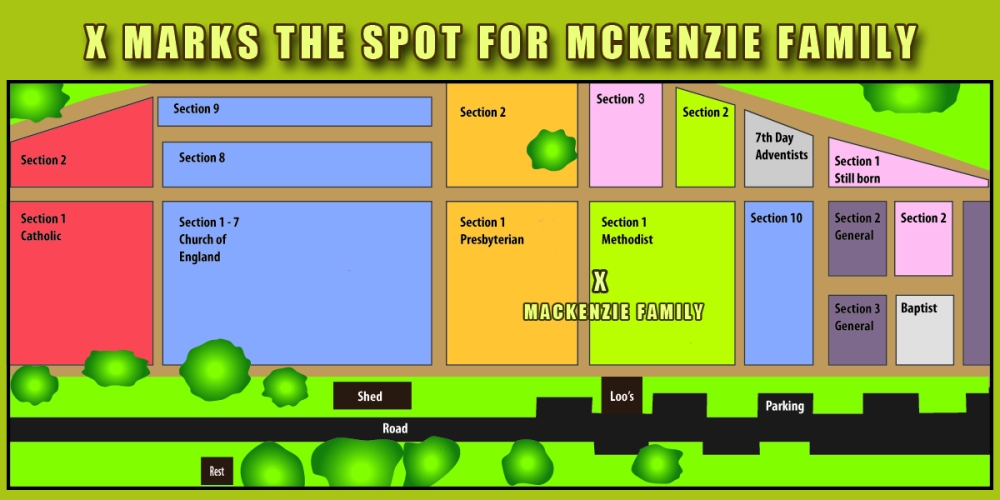
Methodist Section 1 Row 1 Plot 22

plot

Victor J. Mackenzie

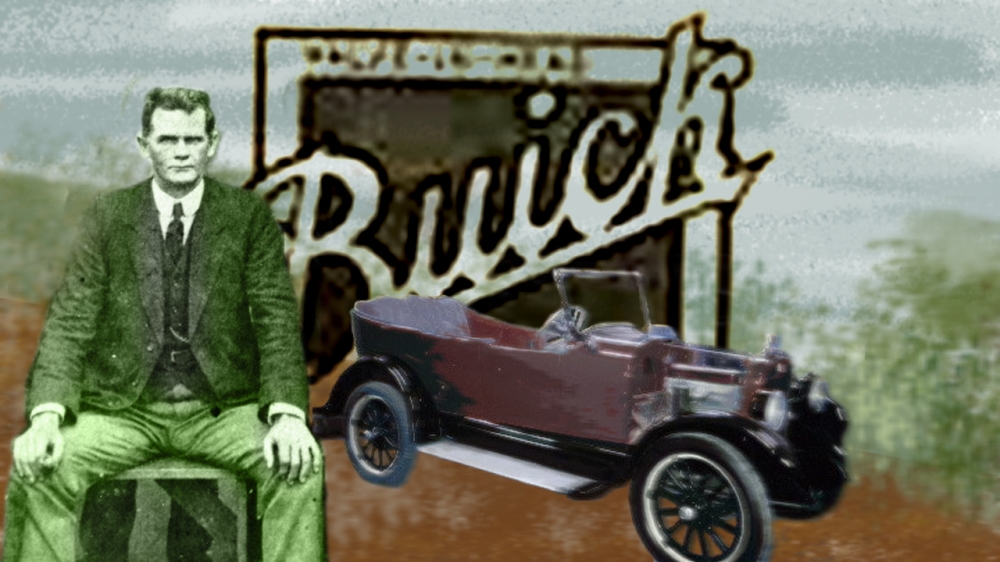
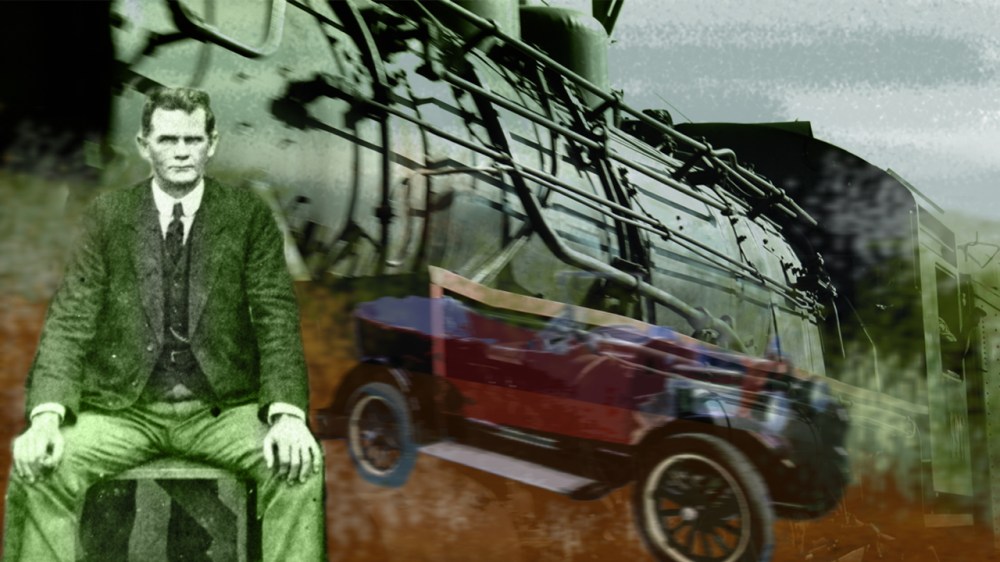
Victor Joseph Mackenzie was a Man about this Town. He mixed in elite circles and was a go to guy for many of the upcoming Council politicians. He was a big strong man , an ordardist and would have known the Adcock’s He participated as a strike breaking action to load oranges onto ships. He knew Robert Baker, he went to Robert Baker’s men’s gathering just before his wedding in 1920 and Baker to his wedding in 1922. He had a wife Thyra and many children. The Train accident would have had a lasting impact on Victor. His mate Robert Baker would normally have been the Coroner, I note that W. E. Kirkness is in his place.
mast head

Gosford Times and  Wyong Advocate

Dated 13 January 1921.

WOY WOY BRIDGE DISASTER.

 Coroner’s Inquests Accidental Deaths

Railway Officials Exonerated.

On Monday morning last, at Gosford Courthouse, the District Coroner, Mr. W. E. Kirkness, J.P., held an inquest regarding the recent Woy Woy Bridge  disaster, which resulted in the deaths of Mrs. Victor McKenzie and her two children, and Mr. C. W. Roughley. The  following evidence was adduced: —    

James Lewis Russell deposed: I am  a police constable stationed at Woy  Woy; I remember the 3rd instant; at about 6.30 p.m. I received a message by telephone from Mr. P. Gillan ; I hurried to the Railway Bridge, Woy Woy; Constable Young, of Newcastle, was also  present; I there saw on the Railway  Bridge the body of a man apparently  the age of 36 years, a boy of about 9years; I also saw the mangled remains of a woman; from inquiries I made I believe that train No. E74 Gosford to Sydney, had just previously run them down and killed them; I also believe  that there was a baby 2 and a half years missing from the party; with the assistance of persons present, I conveyed the bodies to one of Mr. W. J. Parks ‘ cottages close by; next day, about 10 a.m., the body of a female child about 2 and a half  years was found at Mt. Pleasant washed  up on the shore; this was conveyed by  the police and placed with the other bodies in Mr. Parks’ cottage; Mt. Pleasant is about two miles away from the scene of the accident; I have reason  to believe that the body of the child found was one of the party; I have reason to believe that it fell through the  [sleepers of the Bridge into the water below.      

By Inspector Haslam: I believe that there are notices at both ends of the Bridge warning persons against crossing.

Victor Joseph McKenzie deposed: I  am a property owner and reside at Gosford; I remember 3rd instant; the members of my family left home on that date to join Mr. Roughley and his family at Woy Woy; they consisted of my wife, Thyra McKenzie, 42,Edna May, 15 years, Harold John, 8 years, Bruce, 4 years, and Gladys Jean, 2 and a half years; they were all in good health; that was the last time I saw my wife, Thyra, my son Harold, and my daughter  Gladys; their lives were not insured; they did not leave any property.

William Rudland Hawkins deposed :I am an orchardist and reside at Dural; I remember the 3rd day of January ;the deceased, Clifton Wilmott  Roughley was my son-in-law; I last saw  him alive about a fortnight previously;  he went to Woy Woy in company with  his wife and family for a holiday; they  rented a cottage from Mr. W. J. Parks; they were joined by Mrs. McKenzie and  her children; I went to Woy Woy on  the 3rd, and to the cottage occupied by Mr. Roughley; I there saw the bodies of Clifton Wilmott  Roughley, Thyra  McKenzie, Harold McKenzie, and later  the body of Gladys McKenzie; I identfied the bodies of the four persons mentioned; I understand the reason the  party proceeded to Woy Woy by foot  along the line instead of going by boat was the rough weather conditions.

I know that they were run down by the  train while crossing the Bridge; Mr.  Roughley ‘s life was insured in the Colonial Mutual Insurance Office for| about £900; He left a will leaving his wife executrix, and Reginald Roughley  trustee; he was a total abstainer.  Alfred Harold Wilcockson deposed.

train 

I am an engine driver, and employed by the Railway Commissioners; I remember  the 3rd January; I was in charge of train No. E74; I took up duty at Gosford at 4.15 p.m.; I left Gosford at 6.35;  we stopped at Point Clare, Tascott, and Koolewong; we were travelling at about 30 miles an hour; the first intimation I had of anything wrong was the fireman blowing his whistle; the train was then just coming out of the cutting; we were  then about 75 yards from the Woy Woy Bridge;

I immediately cut off steam  when the whistle was sounded as I felt there was danger ahead when the fireman blew the whistle; the fireman said there is someone on the Bridge ; I    looked ahead and saw several people on the Bridge; I at once applied the air    brakes with full force, and reversed the engine; this had the effect of bringing he train to a standstill at about three  cars past the bridge; from the time of applying the brakes the train pulled up within its own length ; I met the guard  coming toward me; he said “we have killed three people”; he said that they were all dead; I then went back to the  engine, and got my detonators and gave  them to the fireman and told him to go and protect the down line by placing detonators on the line; I told him then to proceed to Woy, Woy Station and in form the Station Master of what had occurred; I then got on the engine and moved the trains to allow the guard to take the remains from under the train .

The weather was stormy and raining ;the whistle is a deep toned and strong one, and should have been heard at the Bridge; part of the train was still on the Bridge when I pulled up; the mileage is 45 miles 65 chains; the time of the accident was 6.46 p.m.; when I saw the people on the Bridge. They seemed too confused to get out of the way.

William Thomas Wallace deposed: I am employed by the Railway Commissioners; I remember the 3rd day of January; I was fireman on Train E 74 on that day; the No. of the engine is909; we left Koolewong about 6.42 p.m. the next stop would be Woy Woy; before reaching the Woy Woy Bridge there is a long cutting and a curve; I had a clear view ahead after leaving the cutting; it is about 75 yards from the end of the cutting to the Bridge; I saw several people walking on the Bridge; I at once blew the engine whistle, and thought the people would get off the Bridge;  I called to the driver and told him, and he at once applied the brakes and reversed the engine; this brought the train to a standstill suddenly about three cars past the Bridge; there were also several cars on the bridge; the driver got off the engine and went back the left me in charge of the engine while he did so; he came back and informed me that the train had run over three people and killed them; I was sent to Woy Woy to report the matter; the train was travelling about 30 miles an hour; the driver used every means possible to avert the accident.

Robert Alexander Lindsay deposed: I am employed by the Railway Commissioners as a guard; I remember the 3rdday of January; I was guard on TrainE74 on that day; the train left Koolewong at 6.45 p.m.; when in the cutting before reaching Woy Woy Bridge I heard a blast from the engine; I had no clear view of the line; I heard another whistle, and a few seconds afterwards the brakes were applied with full force; I immediately applied the hand brakes; the train pulled up; I jumped on to the Bridge; I heard a boy calling out “Dadda, Dadda” on the Bridge; I also saw Mr. Roughley ‘s body lying on the down line, also the body of a boy and the body of a woman; the body of the boy was between the two lines and the body of the woman was under the train about the 4th or 5thcar from the engine; I then went forward and informed the driver that three persons had been killed, and to send the fireman to report the matter to Woy Woy and to protect the opposite line on his way; I do not know the span of the Bridge; it is possible for a child to fall between the sleepers into the water below; I satisfied myself that life was extinct when I saw the bodies; I set the train back a few yards to allow the bodies to be removed.

The Coroner returned the following verdict : — “I find that the said Clifton Wilmott Roughley,  Thyra McKenzie, Harold John McKenzie, Gladys Jean McKenzie, at Woy Woy, Police District of Brisbane Water, N.S.W., on January 3rd,1921, died from injuries accidentally received on that date through being struck by a passing train, no blame being attachable to the train officials.”

thyra

Victor remarried in about a years time.
16th February 1922
McKENZIE— WHITE.
A wedding was celebrated at St. Anne’s Church of England, Strathfield, on Saturday afternoon last, when the Rector, Rev. Rose, joined together in holy wedlock, Mr. Victor J. McKenzie and Miss Lydia White, daughter of Mr
and Mrs. R. J. White, of ‘Khandallah,’ Strathfield. Both were former residents of
Gosford, and the ceremony was witnessed by a number of Gosford friends and relatives. The bride, who was given away by her father, Mr. R. J. White, was attired in a grey tailored costume, hat to match, and carried a lovely bouquet of white carnations, cactus dahlias and asparagus fern, the gift of the bridegroom.
Mr. E. K. White acted as groomsman. The bridegroom’s gift to the bride was
a diamond and torquoise ring, whilst the bride’s gift to the bridegroom was
an inscribed gold watch. After the ceremony, an adjournment was made
to ‘Khandallah,’ the residence of the bride’s parents, where the reception was held, and the health of the bride and bridegroom, proposed by Mr. Baker, President of Erina Shire, was enthusiastically honored, and acknowledged by the bridegroom. Among the wedding guests were Mr. and Mrs. William Burns, of Homebush, old time residents of Gosford, Mr. Burns driving the bridal party to and from St. Anne’s in his motor car. Later in the afternoon the newly-wedded couple motored to the Mountains on the honey moon trip. The wedding presents were numerous and costly, including a handsome case of cutlery, the gift of Gosford friends. The future home of Mr. and Mrs. McKenzie will be in Burwood.

buick type

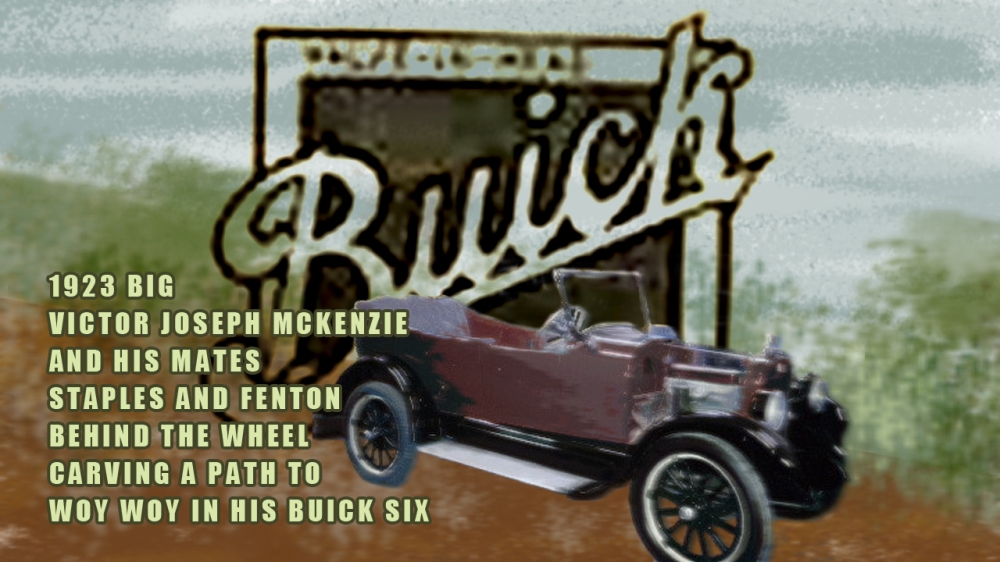
So fast forward a couple of years and Victor is back in the Gosford area and  has become an action man and He is attempting to drive his Buick Six over the ridgeline to Woy Woy the first bloke to do so. Adverts in the local paper have him as a real estate agent and car salesman.

15 March 1923

PRACTICAL ROUTE ROUND THE HILLS DISCOVERED.

Woy Woy’s isolation by road was ended on Saturday last, when Mr. V. J. McKenzie, of Gosford, drove his Buick Six, with the Shire President and Engineer, from Gosford to Woy Woy by a route along the western hills. The bridle track which had previously been used by Cr. Staples on horseback was round to lead through country ,the nature of which would permit of a trafficable road being made at comparatively little cost; and as at last Council meeting £250 was voted for the work from the  Government endowment, to be supplemented by a like amount from the rates, it is hoped that it will not be long before it can be announced to the North, and to the State at large, that motor and other vehicles can come right into Woy Woy.

The approximate distances are in miles:—

From Gosford via Main Road to Boys’ Home                        3 miles

From Main Road along cleared road past Parry’s                 1 mile and half miles

From cleared road over hills to Woy Woy Tunnel                3 and half miles

From  Tunnel over hills to Dillon ‘s Gap at formed road    1 mile

From top of hill down Dillon ‘s Road to bottom of hill       1 mile

From bottom of hill to Woy Woy                                               1 and half miles

‘Pilot’ writes: — When a Buick six cylinder car, driven by Mr. V. J.  McKenzie, of Gosford, and carrying two passengers, Cr. C. J. Staples (Shire President) and Mr. C. J. Fenton (Shire ‘ Engineer) rolled into- Woy Woy on Saturday afternoon, the locals could not for some time be convinced that this car had travelled under its own power and on its own four wheels from Gosford to Woy Woy. Yet this was the  simple- truth. It was all the more surprising because of the fact that, as any Woy Woyan will tell you, the town is isolated so far as road communication is concerned, and even a horse-drawn vehicle has not yet negotiated the rough bridle track running from the Woy Woy Tunnel to the road near the Boys ;  Home, about 3 miles from Gosford.

The news soon got around and caused considerable excitement when Mr. McKenzie’s accomplishment became known. Many were, at first, frankly sceptical, and those who were most inclined to doubt the truth of the report were those who know the track best — for they know from first-hand experience the difficulties of the mountain route.

It was known only to a few — and they had beforehand been sworn to secrecy — that the trip from. Gosford to Woy Woy by motor car was to be at tempted. And here it should be noted that the trip was undertaken without any preliminary examination of the route or any beforehand preparation of the track to be traversed. The ‘overlanders’ did not wish the attempt to be known for fear it might not be successful. When one particularly rough and apparently impassable natural obstruction was met with near the Woy Woy Tunnel, ‘ ‘ Mae. ‘ ‘ remarked, ‘I hope no one has got wind of this stunt in Woy Woy!’ And at this point the venturesome three feared that they would be classed as lunatics if they were to fail and the thing they had attempted became known.

But thanks to V.J. ‘s truly remarkable driving, the car was got through without mishap.

 The Shire Councillors have recently conducted a series of inspection by motor car all over the Shire, and on these trips ‘Mac’s’ skill in negotiating rough and awkward country that most road difficulties can be overcome by a daring and skilful driver.

This prompted Cr. Staples to suggest to Mr. McKenzie that it might be possible for him to negotiate the bridle track over the mountains between the Boys’ Home at Gosford and the Woy Woy Tunnel.

Always ready to tackle a difficult proposition, “ Mac” promptly promised ‘ ‘ to give it a fly.”

It was at first thought advisable to go over the route on foot to make a preliminary examination of the route. But last Friday night it was decided to ‘the attempt the next morning by dispense with the usual preliminaries  in a trip of this kind.

At 9.30 on Saturday morning a start was made from the Gosford Railway station. Three miles by road to the top of thee hill near the Gosford Boys Home was speedily negotiated and the journey really commenced from this point. Where a  cleared track leads off to the south right at the top of the hill. For a mile and a half the going was good, as the road has been cleared for this distance, ending near Mr. Parry ‘s holding.

From here it was found that the bridle track could not be negotiated by car on account of its many windings between rocks and up and down steep places.

A route was chosen over the hills which necessitated much hard work in the way of clearing trees,  grass-tree roots, and sometimes ‘rock chopping,”’ as well as roughly forming steep activities and declivities, and filling in dry water-courses to allow the car to pass. The only accident of the trip was met with about a mile from the Woy Woy Tunnel, one of the rear mud-guards of the car being badly buckled through striking a fallen tree as the car swerved to avoid an obstruction just ahead.

The telegraph line on top of the Woy Woy Tunnel was’ reached at 12.30 — just three hours from the starting time. And, considering the roughness of the country, as well as the fact that at many points the car had to be left while the route ahead was surveyed on foot, this was making good time. At this point it began to be feared that the attempt would prove a failure.

After casting around for threes hours to find a possible’ ascent of the high hills on the south eastern side of the Tunnel a way out was eventually discovered. A little over a mile of exceedingly rough going. in which several sharp, steep climbs had to be made by the car. brought the party on to the formed road at the top of Dillon’s Gap, leading from Woy Woy to Mr. George Dillon’s.

Here the party at last realised that the journey was practically accomplished, and that a few minutes later they would be the proud claimants of the distinction to be the first to enter Woy Woy from the outside by motor car.

At a spring on the roadside the success of the trip was drunk in good, clear water — the first good water that was found during the journey, though the travellers had perforce to drink from many stagnant pools along the route.

 It may be mentioned that no food or drink was carried on the trip — certainly a great over sight! The road down from Dillon’s to the railway line was found to be rough and steep, and its many awkward turns — it is only about 8ft wide with a precipice on one side — necessitated careful driving. But it was easy for ‘Mac.’ compared with the country he had been driving over all day, and the level land was gained without mishap.

Three-quarters of a mile of sandy track brought the car to the metalled road (Railway Street) near the Woy Woy South railway gates, and the car raced from here into Woy Woy with the ‘hooter’ in full blast. ‘The arrival,’ at 4.30p.m., seven hours after leaving Gosford, was celebrated at Hadley ‘s with a bottle of champagne, the cork of which ‘Mac.’ annexed as a souvenir’ of the great occasion.
vic pic


alfred vic

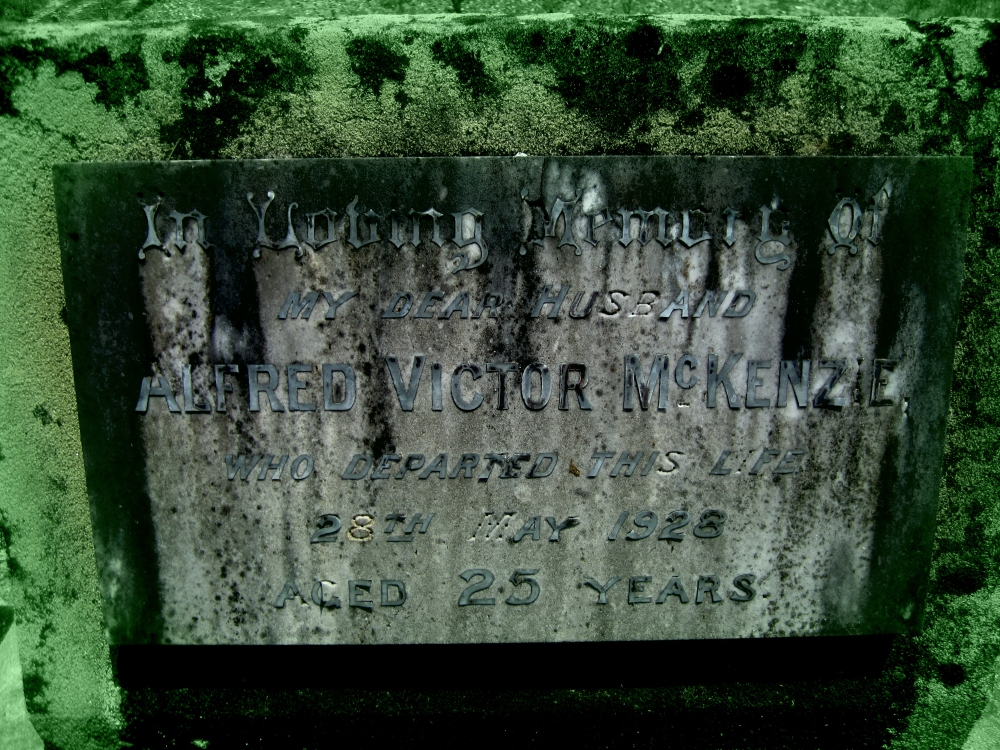
Then this happens his 25 year old son gets sick and dies.

7th June 1928

OBITUARY

ALFRED VICTOR McKENZIE.

The sad death, occurred in Quirindi Hospital on Monday evening, May 28, at 9. 15 p.m., of Mr. Alfred Victor McKenzie, aged 25. Deceased took suddenly ill a fortnight prior to his death, and was taken to Quirindi Hospital, suffering from enteric fever. Despite all  efforts by the three doctors and two nurses (one of whom, Sister McKenzie, was his sister), the patient gradually grew worse, and succumbed) on the Monday night.

Mr. McKenzie was operated upon on Monday afternoon, as a last resource. He rallied after the operation, but only temporarily. His father, Mr. V. J. McKenzie, of Gosford, Sister G. McKenzie, and sisters-in-law from Mosman were with him at the end.

The news of deceased’s serious illness, and then of his death, was very distressing to a large circle of friends and relatives in the Gosford district, all of whom held him in high esteem.

Mr. A. V. McKenzie, who was in the service of the Government Savings Bank of N.S.W., had been stationed at Quirindi for the past six years, and held the position of teller at the time of his death. Joining the Bank at Gosford (after a short term on the Railway staff at Gosford) he was attached to the local Branch for a number of years, after which he was transferred to Edgecliffe, and later to Quirindi. The late Mr. McKenzie was married in February last to Miss Dorothy Ferguson, at Mosman. Many friends sympathise deeply with the young widow, and with the other bereaved relatives in the sad loss they have suffered by his untimely passing. The mourners include Mrs. A. V. McKenzie (widow), Mr. V. J. McKenzie (father), Mrs. T. H. Pryor (sister), Mrs. Ray Fagan (sister), Nurse G.  McKenzie (sister), and Master Bruce McKenzie (brother). A shocking tragedy at the Woy Woy railway bridge on January 3, 1921, was responsible for the death of three members of the family — the late Mrs. V. J. McKenzie, and a daughter and son, aged 8 and 2.5 years. The Funeral On the arrival of the Brisbane Mail at Gosford on Wednesday morning, May 30, the cortege moved to Point Clare Cemetery. The hearse was followed by over 30 cars. At the cemetery the coffin was borne to the Methodist portion, and laid at rest beside the graves of deceased’s mother and little brother and sister. The Rev. G. A. Baily, Gosford Methodist Minister, officiated at the graveside, which was surrounded by a host of family friends.

Mr. Baily delivered a very impressive address. Among the relatives at the graveside were Mr. and Mrs. V. J. McKenzie, Mr. and Mrs. T. H. Pryor, Mr. and Mrs. B. Fagan, Bruce McKenzie, Mr. and Mrs. Alf. Sterland, (sister and brother-in-law), Mr. and Mrs. Ferguson (mother and father-in-law), Mr. A. Wane (brother-in-law), Messrs. McQueen and Reichendah, of Quirindi, near friends of deceased, were also at the funeral.

Among the wreaths, the following cards were noticed: — From Daddy, Mummy, and your Sisters; Florrie and Tom; Marj, and Arthur; Ray and Edna; Lal. and Norm; Sterland Bros. And Arthur Wane; Mr. and Mrs. Wallace Moore; Mr. and Mrs. V. F. Fagan; Mr. and Mrs. Bert Moore; Mr. and Mrs. D. G. Pryor; Mr. and Mrs. J. F. Sterland; Syd and N. Gregory; Members of Quirindi Golf Club; G. And F. May; Mr. and Mrs. Creighton and Family; Lodge Rising Sun, Gosford; Mr. and Mrs. B. J. Stephenson, Daphne, and Duncan; Mr. and Mrs. F. G. McPherson; A. and L. Tetsell; Mr. and Mrs. S. J. Black; Mr. and Mrs. A. A. Gollan and Family; Mr. Breakspear, Inspector, Bank; Mr. and Mrs. B. A. Hill and Family; Mr. and Mrs. A. E. Murrell and Family; Mr. and Mrs. Clarke, Mr. and Mrs. Croal, Mr. and Mrs. Galloway, Mrs. Merchant; Edith and Lyal Sutton; Mr. and Mrs. Macqueen; Mr. and Mrs. F. Wheeler and Family; Charles T. Hills; Thomas Bros.; Dr. and Mrs. Howell, Quirindi; Mr. and Mrs. Parr, and Staff, Govt. Savings Bank; Mr. and Mrs. A. M. Nyall; Gosford Agricultural Association; Mr. and Mrs. H. Benson and Family; Mr. and Mrs. B. L. Campbell, Quirindi; Mr. and Mrs. G. Stephens; the Anderson Family; Mr. and Mrs. B. Hill; Dr. and Mrs. Magill; Commissioners, Govt. Savings Bank of N. S.W.; Mr. and Mrs. Bathgate; Mr. and Mrs. L. W. Mason; the Margin Family.
vic green

ic train

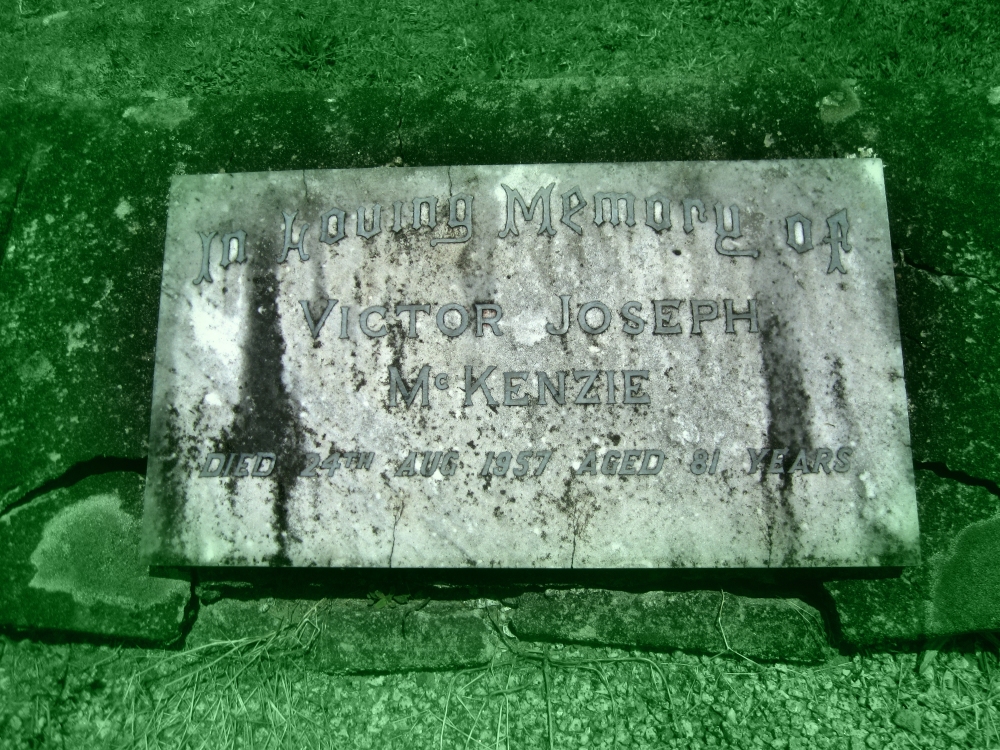
The last mention of Victor J Mckenzie was in 1938 when he lived in Manly. He died in 1957 aged 81.
Richard Henry Creighton and family

map templateDulciebella Mary Creighton mother of Richard Henry Creighton The article notes she is buried at Point Frederick Cemetery with her husband, that is a long since closed down cemetery for really old school locals. Her son Richard is possibly the first of his family to be buried at Point Clare Cemetery.
foot

4th March 1920

DEATH OF MRS. CREIGHTON,

SENIOR.

On Sunday last Mrs. Dulciebella Mary Creighton, relict of the late Robert Creighton, died at Gosford at the age of 88 years, after a brief illness extending over three weeks. Deceased was born at Balmain, and when a girl came to Booker’s Bay, Woy Woy, where her father, Mr. Henry Piper, carried on business as a shipwright.

Practically all her life she resided in Brisbane Water district with the exception of a few years spent in Sydney and Melbourne. She leaves a family of three — Mr. Richard Creighton (Gosford), Mrs Harry Hammond (Gosford), and Mrs. W. Cassells (Camperdown), two other of the children (a son and daughter) failing to survive their mother. The late Mrs Creighton also leaves a number of  grandchildren and great grandchildren. The remains were interred in the Church of England portion of Point Frederick Cemetery, being laid to rest alongside those of her husband. Rev. A. Renwick, Rector of Christ Church, conducted the graveside service.

Richard Henry Creighton married into the Meehan family in 1916, Richard and Kathleen are buried here at Point Clare Cemetery, in the Lawn section. Lawn 5 row 5 plot 62

26 October 1916

WEDDING. CREIGHTON—MEEHAN.
A pretty wedding took place at Christ Church, Gosford, on Tuesday, October 17th, when Miss Kathleen, third daughter of the late Mr. and Mrs. Edward Meehan, of Newcastle, was married to Richard Henry (Dick), only son of Mr. and Mrs. Richard
Creighton, of Gosford. The ceremony was performed by the Rev. Arthur Renwick (Rector) assisted by the choir. Mr. J. W. Lees presided at the organ. The church was very prettily decorated by Mrs. F. Wheeler, who also constructed a handsome
archway of white lilies, sweet peas, and roses, in front of the altar, under which the happy couple were joined in the bonds of matrimony. The bride, who was given away by her uncle, Mr. Jack Allen, of Randwick, wore a beautiful china silk costume with hat to match. The bridal bouquet was of white sweet peas, stock and roses, and, with a silver purse, was the gift of the bridegroom. The bride was attended by Miss Agnes Meehan (sister of the bride) who wore a pale pink silk crepe frock with hat to match, and Miss Edith Creighton (sister of the bridegroom) who was attired in a cream silk crepe frock with hat to match. Their bouquets were of pink sweet peas, stock and
roses, which, with gold bangles, were the gifts of the bridegroom. The bride’s gift to the bridegroom was a gold mounted fountain pen. Mr. Walter Briscoe (of Greta) acted as best man, and Mr. Thomas Hennessey (of Randwick) as groomsman. Rev. A. Renwick presided at the reception, which was subsequently held at the Gosford Hall, when over sixty guests were received by Mrs. Creighton (mother of the bridegroom), who was attired in a black silk poplin with hat to harmonise. After the usual toasts
were honored, singing and dancing was indulged in. On leaving for the honeymoon, which is being [held?] at the Blue Mountains, the bride was attired in a beautiful blue satin charmeuse, with black tulle hat relieved with blue water lilies.

stone

Richard Henry Creighton

3rd Generation Funeral Director

DOD 22 September 1931      Church of England Section 1 Row 4 Plot 88

Aged 71 years

His family moved here in 1844,

His grandfather was a carpenter/builder who began making coffins and then went into funeral directing from that as a start into the industry. His business was the first Funeral Directors in the district. The workshop and residence was on the old Public School site where the proposed tax office is to be built….. death and taxes… hmm he made the pews for the Church of England church,,, the one that got moved from East Gosford. Richards Father was also a builder and built the old public school then followed his father into the funeral directing business.

Richard also followed into the family business making him the third generation , and the current generation of Creighton’s is the 5th. Richard loved cricket and sailing and was involved in organising and participating in regattas and competitions on the Brisbane Waters. Richard married into the Parry family another well known Gosford family name, marrying Emily Parry. The nature of his work made him one of the most respected men in the region, he was seen as a friend in need, never a bad word was said of him and was not prone to gossip. He saw many locals in their moments of venerableness. Richard was on the verge of retiring with his son learning the business and had book a holiday with his wife when he died. The first funeral his son participated in was that of his fathers.

24 September 1931

BEYOND THE VEIL
MR. R. H. CREIGHTON.
The death of Mr. Richard Henry Creighton, which took place at his residence at Gosford last Monday, following an attack of pleurisy and pneumonia, removes one of the oldest and most respected residents of the Brisbane Water District. Born at Gosford 71 years ago, his life was spent in this district except for short periods when he was engaged in gold-mining in the Narrandera district. He was a man of exceptionally high personal character, one who appreciated and lived up to a true ideal of service to his fellow man.
As a builder and contractor he was known throughout the district for the excellence of his craftsmanship, and everything that he did was characterized by the same thoroughness. For many years he had conducted the undertaking business of Messrs. R. H. Creighton & Son.
The late Mr. Creighton is survived by a widow, four daughters, Mrs. J. Sohier (West Gosford), Mrs. Don Robertson (Newcastle), Mrs. C. Morris (Gosford), and Mrs. J. Barnes (Gosford), and one son, Mr. Richard Creighton, of Bronte and Gosford.
The funeral took place yesterday afternoon, the Rev. A. E. Saxon conducting the service in the Church of England portion of the Point Clare Cemetery. An account of the funeral and other particulars of the life of the deceased will appear in our next issue.
col creightons

Here is a September 1951 advertisement for the business

A Century of Service

Established in Gosford in 1844, the business of Funeral Directors has been carried on continuously over a period of 107 years by succeeding generations of the Creighton family — an unbroken line to the fifth generation.

The founder, Robert Creighton, was succeeded by his son, Robert Creighton Jnr., he in turn by his son, Richard Henry Creighton, followed by Richard Henry Creighton Jnr., whose

son, Richard John Creighton, represents the fifth generation of the family actively engaged in the business founded 107 years ago.

The code of service established by the first Robert Creighton

has in the succeeding years become a tradition, rigidly maintained but improving with the march of modern progress.

Today, the service is of the most modern description, and the establishment is the largest in any country town of the Commonwealth. Its plant is equal to anything in the cities.

There are two modern motor hearses and a new Chrysler chassis has recently been purchased for a third hearse.

The Casket Factory, built by R. H. Creighton Snr., in 1910, is still is use, but it is intended at an opportune time to build a The Chapel,- which forms part of a new, modern building in

Mann Street, Gosford, is dignified yet simple in its architectural style. When conditions warrant, additional Chapels are to be built at The Entrance, Wyong and at Woy Woy.

Today, the service covers the Brisbane Water District and funerals are conducted to all parts of the State. There are representatives in all the capital cities of the Commonwealth.

In order to further extend and improve the service, the firm was recently incorporated under the Co’mpanies Act, with ( Mr R. H. Creighton, who has had extensive experience both ‘ here and in other parts of the State, as Managing Director.

Incorporation will ensure the continuity of operations and the tradition of service will be maintained in the years to come.

RH CREIGHTON

CENTRAL COAST FUNERAL SERVICE PTY LTD

rock of ages

The stone of a girl clinging to a cross is quite a common one in the mid century, called “Rock of Ages”, there are examples of it at Waverley, Rookwood and Northern Suburbs Cemetery’s.

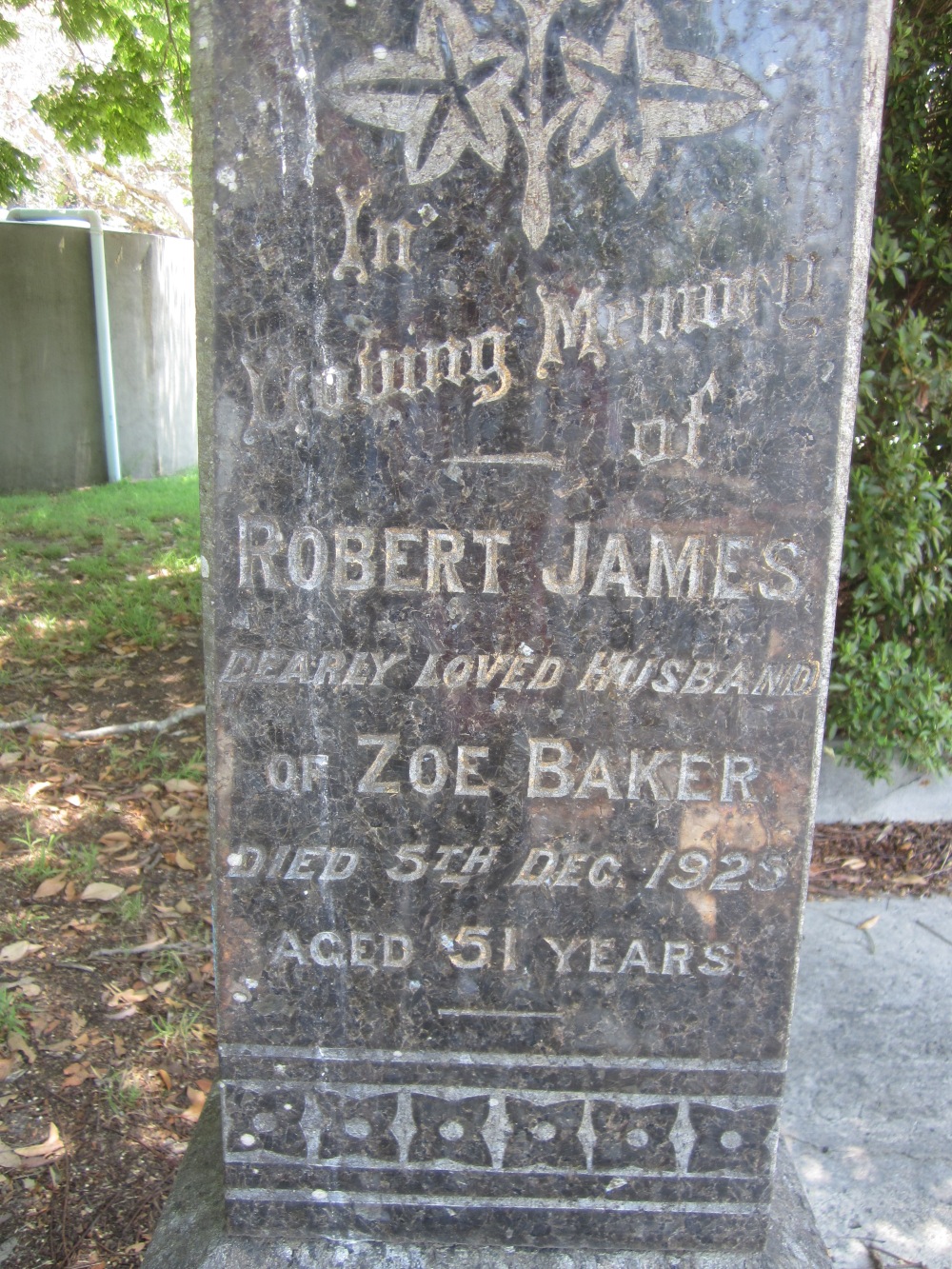
Robert Baker

map template

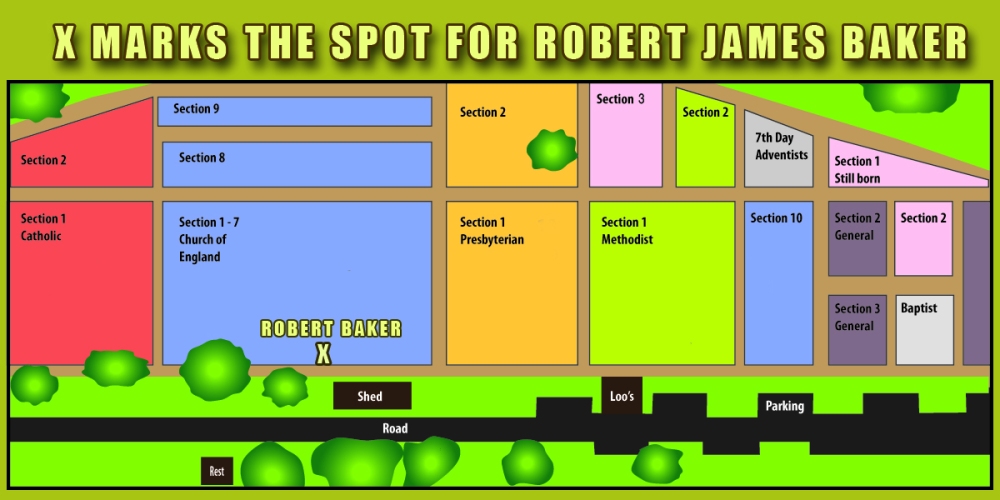
Church of England Section 1  Row 6  Grave 125

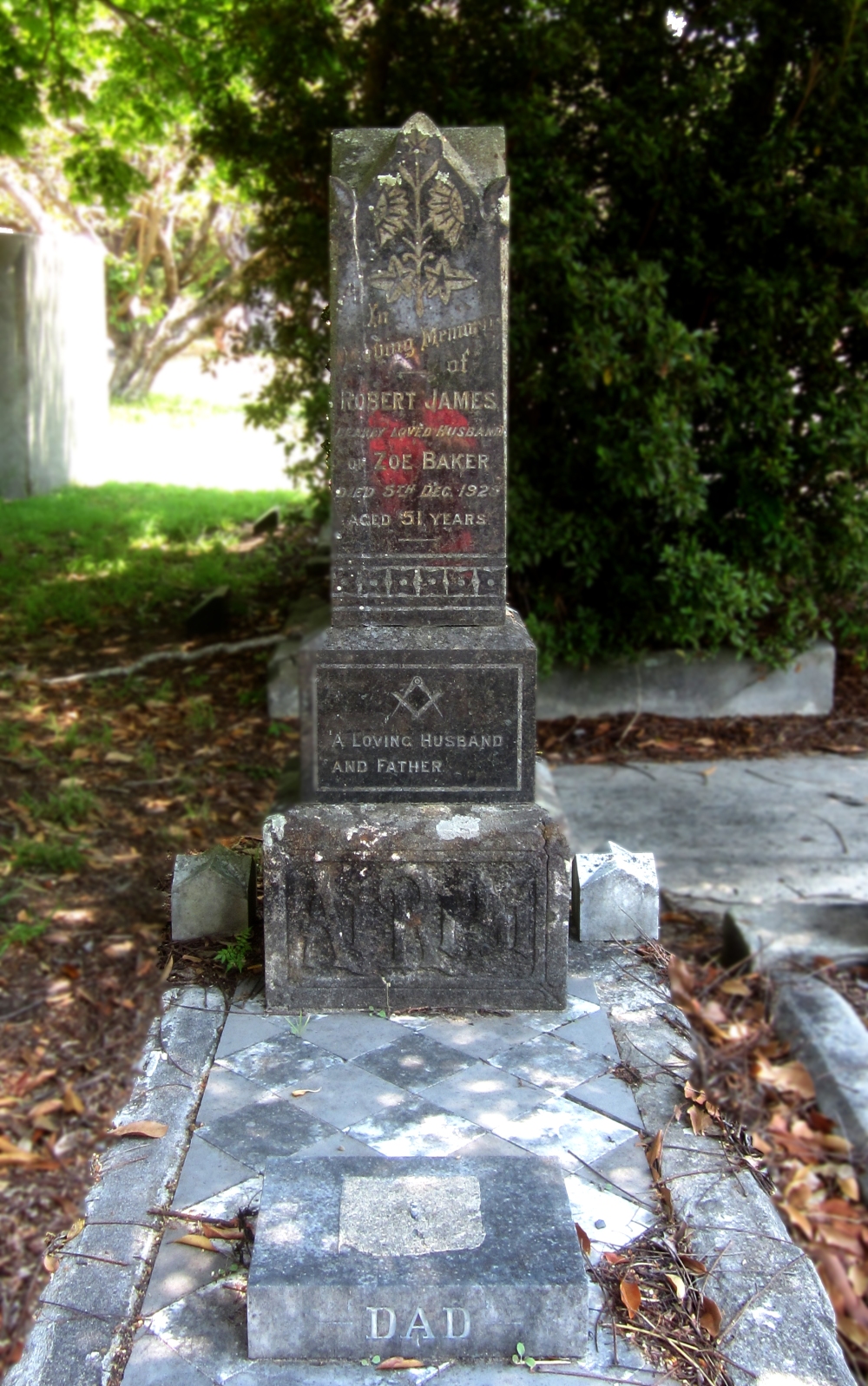
Robert Baker

The Public Life these news articles refer to is he was the District’s Coroner up until his death and the position was then taken by William E. Kirkness.

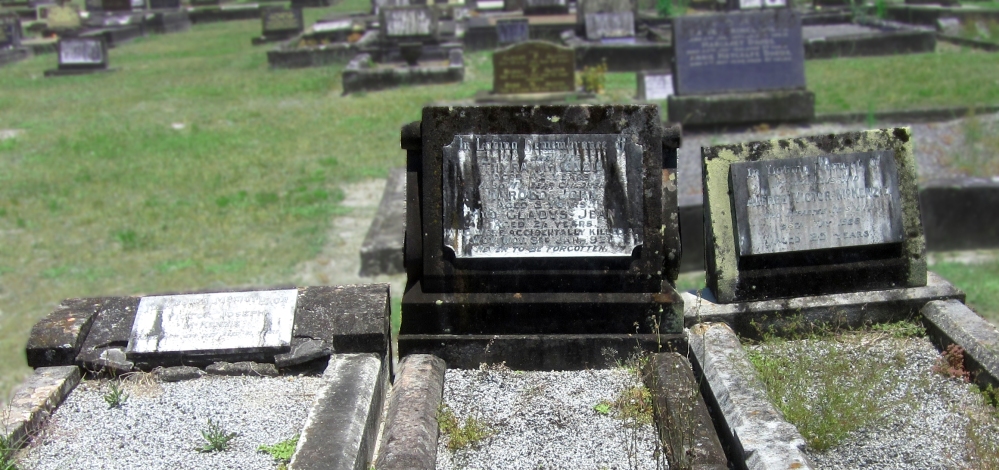
Had there been any deaths by accident in the area from 1916 to 1925, the graves in this cemetery would have been attended by Robert Baker, in his role as Coroner.

The news articles about all these deaths would have been written by him or his journalists for his paper. He had been dead for four years when is son died in 1929, at Terrigal Byron ”Sonny” Baker who is mentioned in an earlier blog post.

9th December 1920

In honor of her approaching marriage Miss Zoe Mason was entertained at a ‘White Tea’ ^ Mrs. A. I. Chapman’s residence on Wednesday afternoon, 1st instant. There was a large gathering oi ladies, including members of the Orchestral Society.

The Mason’s had a son Lance, brother of Zoe, who was referred to who is mentioned in an earlier blog post for Cecil Morris the Policeman’s son in his final letter to the newspaper in 1915. Bakers journalist’s mind had the foresight to get these young boys writing to him for his paper getting first hand accounts of the Great War.Zoe ‘s father was a local magistrate, J. J. Mason, and the family lived in Point Frederick in a house named “Waterville”.

Zoe married Robert Baker in 1920. This is the sort of wedding write up if you happen to own the paper.


mast head

9th December 1920

Wedding Bells.        BAKER— MASON.

Yesterday afternoon the wedding of Mr. Robert J. Baker, President of the Erina Shire Council, and Proprietor and Editor of the Gosford Times, ‘ ‘ with Miss Zoe Mason, daughter of Mr. and Mr. J. J. Mason, ‘ Waterville,  Gosford, was solemnised in the Sacristy of the Roman Catholic Church, Gosford, Rev. Father John Kelly officiating.

Though heavy rain was falling throughout the day and whilst the ceremony was in progress, a large gathering of the public was present in the church.

Both bride and bridegroom being very popular in the district. The bride looked particularly charming in a white crepe-de-chene wedding dress, with deep flounces of white georgette, edged -with seed pearls. A tunic ornamented with jewelled trimming was worn, and the beautiful veil of Brussels net and hand-embroidered Honiton point, arranged in Juliet cap fashion, trimmed with orange buds, was loaned by Mrs. Guy Parr and looked strikingly effective. Given away by her father, the bride was attended by her sister, Miss Marie Mason, as brides maid, who wore a pale blue crepede cuene frock dra*ped fashion, with trim mings of pale pink georgette, and picture hat of similar shades, trimmed with fruit and flowers. The bride’s mother was gowned in amethyst georgette and crepe-de-chene, brocaded tunic, with floral hat to match.

Mr. Fred C. Warmoll acted in the capacity of Best man. The gift of the bride groom to the bride was a handsome diamond pendant set in platinum and a beautiful bouquet of lilies of the valley.

The gift to the bridesmaid was a gold bangle, also a shower bouquet of pale pink carnations.

Whilst the register was being signed, Miss Ursula Mason, sister of the bride, and Gosford ‘s prima donna delighted those present in. A perfect rendering of the exquisite ‘Beloved it is Morn,’ and as the happy couple left the church, the Wedding March, played on the organ by

Mrs. Passlow, sped them cheerily on their way. Mr. and Mrs. Mason entertained relatives and a few near friends fort a sumptuous breakfast at ‘Waterville,’ East Gosford, where the usual toasts were most enthusiastically honoured.  

The door attendant was kept busily engaged in receiving telegraphic despatches wishing the ,-newly-united pair the happiness they deserve, and after an inspection by the guests of the many valuable gifts received, the party accompanied Mr. and . Mrs. Baker to the railway’ station where much merriment and good feeling prevailed.

The train on, leaving ; the’ station discharged a royal salute of detonators which had been placed on the line, and to the accompaniment of loud cheering, much confetti, and joyous ‘ ‘ Cockadoodle dooing’ from the engine, the happy couple left for Sydney on a few weeks’

honeymoon in the mountain country, carrying with them the best wishes of the whole of the district.

The bride travelled in a charming frock of champagne georgette and crepe-de-chene, accordion pleated, and embroidered in latest pastel shades, and wore a pretty little French hat of Henna and champagne trimmed with fruit and streamers. Amongst the presents noticed

was the handsome plate consisting of a charming rose-bowl and set of entree and cake dishes, the gift of ninety of Mr. Baker’s friends.

IMG_7126

A short five years later Robert dies leaving Zoe Mason/Baker becomes a widow.

5th Dec 1925

 Aged 51 Newspaper publisher.

10th December 1925

TRIBUTES

TO THE LATE MR. R. J. BAKER.

AN APPRECIATION BY MR.

W. E. KIRKNESS.

As one who has been closely. associated with Robert Baker in most public affairs since his arrival in Gosford, 16 years ago, I wish to add my tribute to his worth as a friend and a citizen.

He had his limitations, and acknowledged them, but we can well afford to let any shortcomings of his fade into the past of our forgetfulness, because our own faults are ever before us. His virtues and generosity were of a high standard, and over stood for the advancement of his fellowmen, and of this town and district in particular.

The journal that he conducted -was clean in principle, broad in sympathy, and progressive in character. He will be missed and mourned by the whole of the district.

His death means a personal loss to many of us. I know of many persons who, in time of need have financially helped him, and he never went back on a friend. These arc the qualities that lift men above .their faults, and exalt the remembrance of their life and name into a sweet experience.

10th December 1925

The Passing of R. J. Baker.

Widespread Mourning.

Popular Pressman and

Respected Public Man.

 After an illness which caused him suffering over a long period, Robert James Baker passed from this life, in Lewisham Private Hospital, in the very early hours of Saturday morning last.

The very best of medical skill had been called upon, but the doctors were powerless to avert the cruel fate which took from this community, and from the State at large, one of its most valued

citizens, when he had spent most of the half-century of his life in strenuous work, but before he could enjoy any of the ease he had so thoroughly earned.

His passing has been a blow keenly felt by all sections of the community. Robert James Baker was a man who never spared himself, in the common tasks of his business or in the service of the public. And he was a man who never turned down I a genuine plea for help. The result of a life lived on those principles was seen on Monday, when a whole district turned out to pay a last mark of respect to its most esteemed citizen, and to I

mark deep sympathy with those who have been cruelly bereaved by his death. Mr. Robert James Baker has gone, more’s the pity. But the work that he has done for Gosford— and for the districts-will I never die.

.The late Mr. Baker, who was born at Hill End on the 8th August, 1874,

was the only son of the late Mi- Henry Baker, of Hill Bad and Emmaville. He served his apprenticeship on the Emmaville ‘Argus,’ and at an early age displayed exceptional ability both as a practical printer and all-round journalist. At the age of 21 he was engaged by the late Dr. Ross, M.L.A., to man age the Molong ‘Argus,’ which in a few months he acquired as his own property.

He conducted this paper with very great success for nearly ten years, eventually selling it to the Hon. J. C. L. Fitzpatrick, M.L.A. Mr. Baker then purchased the Peak Hill ‘Express,’ which he speedily trans formed into one of the best weeklies in the Central West. During his period (four years) of residence in Peak Hill lie took a very active part in public matters.

He was secretary of the Agricultural and Pastoral Association, Secretary of the Jockey Club, and of the Curra Amateur Race Club. On his leaving Peak Hill he was publicly entertained by town and district residents and presented with a gold watch (suit ably inscribed), and massive gold and belt.  After disposing of his Peak Hill paper, the subject of this sketch enjoyed a well-earned six months holiday.

He then, just sixteen years ago, ‘acquired the ‘Gosford Times,’ which wry quickly  evidenced that dynamic energy which had always characterised his work as a pressman.  A few years ago Mr. Baker established the ‘Woy Woy Herald,’ and both papers were under his sole control up to his death. The late Mr. Baker was one of the foundation members of the New South Wale- Country Press Association. He was a member of the Executive for some 20 years, a Vice-President for three years, and President for two terms in 1920-22.

For many years he was a director of the Country Press Co operative Company of Australia, Ltd., and also n Vice-President of the Australian Provincial Press Association. Of the 300 members of the Country Press Association, none had displayed more well-directed activity in the affairs of the Association, and no member was more highly esteemed or will be more misled than Mr. R. J. Baker.

The late Mr. Baker was twice married. In 1902, He was married to Miss Margaret Black, of Forbes, to whom four children were born — Misses Thelma. Edna, and Lola, and Mr Henry

Georgia Baker. His first wife died in 1917. and in 1920 he married Miss Zoe Mason, daughter of Mr. and Mrs. J. J. Mason, of Gosford, who, with three little children, survive him.

type case
Here is a brief history of the Gosford Times after Robert J Baker died.
14 December 1954
When the late Robert James Baker in 1913 erected the two-storey brick building at 144-146 Mann Street, Gosford, he no doubt believed that he was establishing here
the permanent home of “The Gosford Times.”
After his death, the property and the paper were purchased by Mr. Stanley Kings
bury, who converted the building into two shops and erected a fibro and weather
board building at the rear to house the paper.
Now the property of P. J. Palmer & Son Pty. Ltd., the original building has been
modernised ‘and extended to provide a large menswear store for the city company —
one of its many branches in NSW.
The next move, so far as “The Gosford Times” is concerned, will be to a new two-
storey brick building, now in course of construction at 1 35 Mann Street, Gosford. This is planned to take place in 1 April 1955.
 This Scribe


IMG_7127

Point Clare Cemetery War Graves

two same numbers

Point Clare Cemetery War Graves

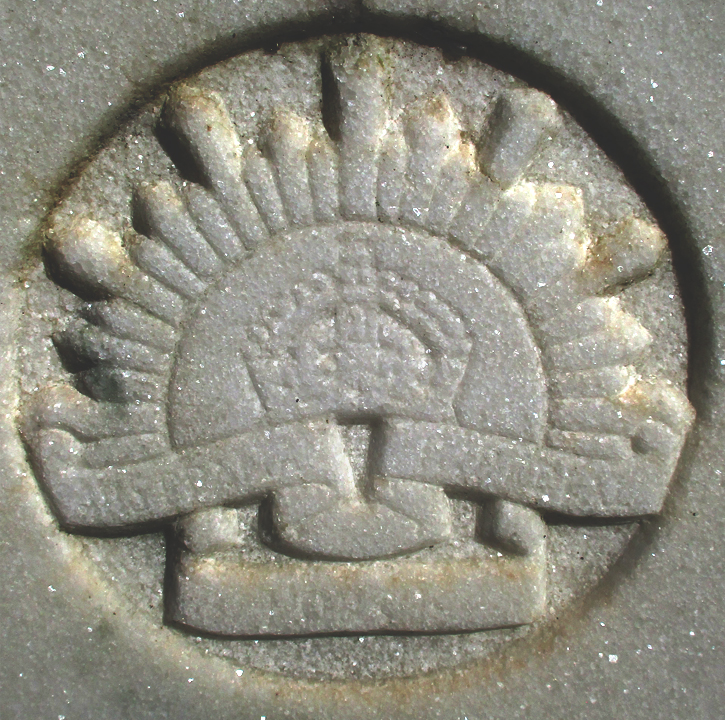
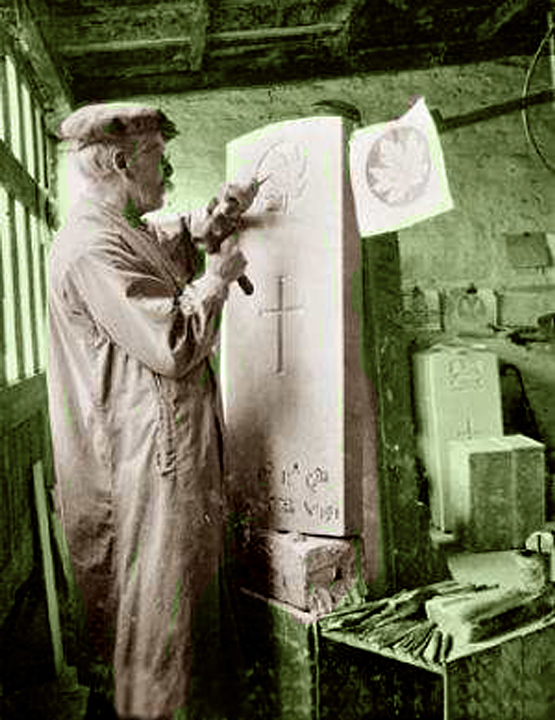
Until the mid 1950’s all returning servicemen and women could if requested by the family, receive the honour of a beautiful white marble or brown granite headstone courtesy of the Commonwealth War Graves Commission. There are in total 23 Official War Grave Headstones that are the traditional headstones, maintained by the Commonwealth War Graves Commission (They maintain, weed and clean them annually).  After sometime in the 1950’s they ceased to issue the stone headstone and reverted to a brass plaque to commemorate the War dead.

The stone headstones are made of the white marble from South Ulam in Queensland and is used for Australian war graves throughout the world. South Ulam marble is a metamorphic rock that is created from limestone after it has been subjected to extreme heat and pressure. The size of the calcite crystals in South Ulam marble has been determined by the amount of metamorphism it had been exposed to.

Marble that has been exposed to higher levels of heat and pressure generally have larger calcite crystals than it would have otherwise. These over sized crystals is what makes these war graves sparkle the way that they do.

crest

There are also brown stone war graves at Point Clare Cemetery, they are made from a stone called Trachyte, which is a fine grained form of granite from the Southern Highlands near Bowral NSW.

The Commonwealth War Graves Commission assures me that they do not make mistakes when it comes to the War Graves at this or any other cemetery and that their records are a true and correct reflection of what is at ground level at the site. I beg to differ. There are mistakes as to the number of stones/what they are made of, service numbers of the soldiers and the details on the stones (like the age when the soldier died).

For the number of mistakes in this cemetery alone, Point Clare is by no means one of the largest cemeteries in the country, one can only imagine how many other mistakes there are on stones in other cemeteries around Australia.

mason

The Commonwealth War Graves Commission’s records reflect that there are seven white Marble stones and that the rest are of the brown trachyte granite. As you glance around Point Clare Cemetery you will see several of the white Ulam Marble  war grave stones and it will not take you long to count more than seven of the white ones. My estimate is there is thirteen of the white marble stones all up. But there is an even more curious mistake amongst these war graves but I will get to that a bit later. Including one that is not on their official list (P. J. Wells). It is to our benefit that there are more of the white marble stone than the brown trachyte one as the white stones just sparkle and gleam back at you.

digger

Not all of the people in these graves made a name for themselves in the local paper, which is my primary source of information for all of this cemetery some of the following is information gleaned about these some returned soldiers from either the local paper or their war service records. I will in time add to this list and attempt to find information about all 23 of these returned service men. There is no particular reasoning as to why someone gets a white or a brown headstone, but there is an effort to conserve some of the white marble as it is a finite resource reserved for the Commonwealth War Graves in other countries.

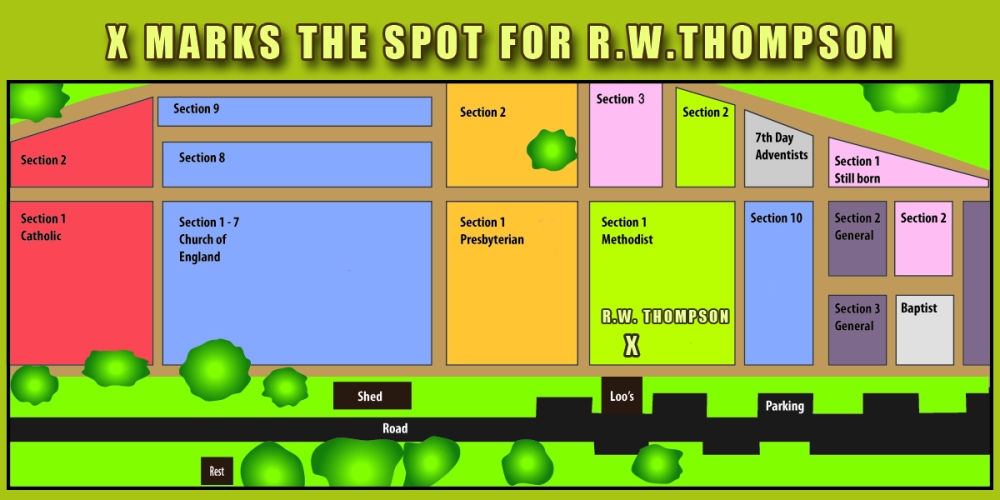
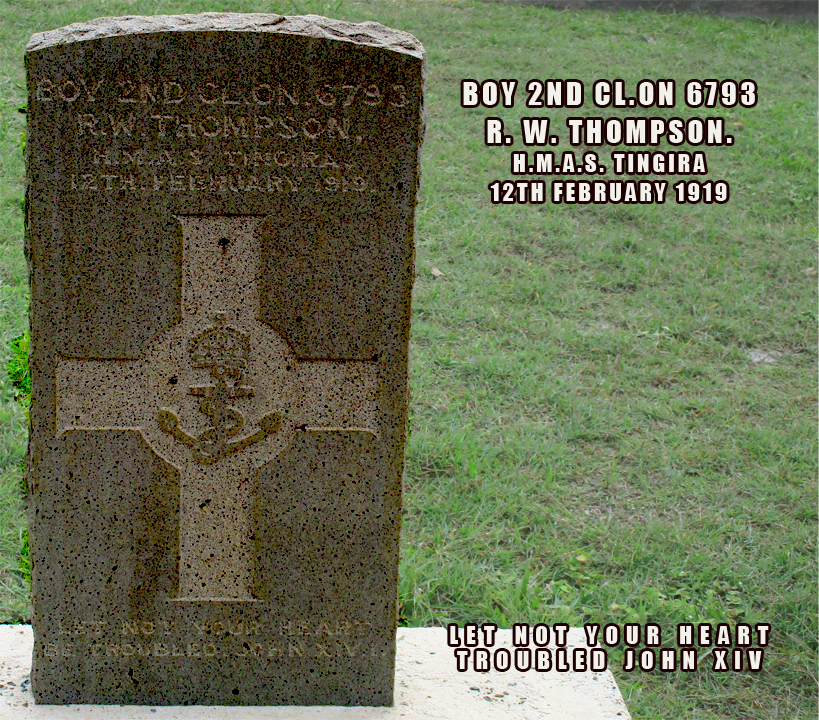
There is only one stone that was erected during the wars (either WW1 or WW2) a brown trachyte stone. This is the grave of Reginald Thompson, a 16 year old Naval cadet who went AWOL and committed suicide in the bush up at Somesby in the summer of 1919.

Reginald Thomas enlisted 19 August, 1918, His service record is only 2 pages long, he had “Straw” coloured hair fair complexion and blue eyes. He was 5 foot 4 inches tall. He has a scar on his right  third finger on the inside. He died on or about 14 January, 1919. The navy approved an expenditure of £10 in respect for his funeral and that money was forwarded to the Next of Kin. That is the extent of his service record.

reg map

Reginald Thompson       Aged 16                14/1/1919

Methodist Section 1       Row       1              Grave 9

Service number                6793                 Brown Trachyte Military Stone

20th February 1919

Sad Suicide Case.

Naval Trainee Strangles Himself.

About 6 p m. on Thursday last Ernest Gambling accidentally came across a body suspended from a dry tree limb at Somesby about 50 yards off the main road. His attention was drawn to the spot by a horse rug which was also hanging from the tree.

He immediately rang up the police, and Sergeant Morris proceeded to the spot. The body was dressed in a striped cotton shirt, dark tweed coat and black sailor trousers. A pair of heavy boots with cashmere socks was lying close by.

There was also a bundle of sailor clothes near the spot bearing the names ‘ H. M.  A..S. Tingara ” and  R. W. Thompson.

The body, which was badly decomposed, was suspended from the tree limb by a cord attached to the boy’s neck. It was not sufficiently long to permit of any drop, and the lower portion of the body was practically resting on the ground.

In the breast of the coat pocket the Sergeant found a leather purse containing 17s Id.

Subsequently the body was identified by Mr. Robert Parsons and Mr. Henry Clarke as that of a lad named Reginald William Thompson. Deceased spent a portion of his Christmas holidays at Mr. Parsons’ place, and towards the end of his stay Mr. Parsons stated that the lad became very despondent and did not wish to return to the H.M.A.S. Tingara, where he was a naval trainee.

On Saturday an inquest was held at the Courthouse by the District Coroner, Mr. R. J Baker.

Mr. John W. Thompson, of Camperdown, stated that deceased was his son, aged 16 years and 8 months, and had been a trainee on the Tingara about six months. The lad had been on a holiday, spent at Mr. Parsons’ place, Somersby, and returned home on the 5th January.

He was due to return to his ship on the 13th and left home that day with his kit all packed up, and the parents were under the impression that he had gone back to the boat. But instead, the boy took train to Gosford and walked to Somersby, where during the night he secured a couple of rugs and lantern from the residence of Mr. Parsons, and, going into the bush about 300 yards away, nailed one of the rugs (a horse rug) to a tree.

Later on, probably next day or night, he placed his sailor uniform cord around his neck, the end tied to the limb of a tree, and in this determined way strangled himself.

The body was not found till a month later. A verdict was returned that the deceased died fron suffocation wilfully caused by strangling himself on or about the 14th day of January, 1919.

The remains were interred in Point Clare cemetery

thompson stone

Service record for Reginald Thompson

https://recordsearch.naa.gov.au/SearchNRetrieve/Gallery151/dist/JGalleryViewer.aspx?B=4523951&S=1&N=2&R=0#/SearchNRetrieve/NAAMedia/ShowImage.aspx?B=4523951&T=P&S=2

scanlon map

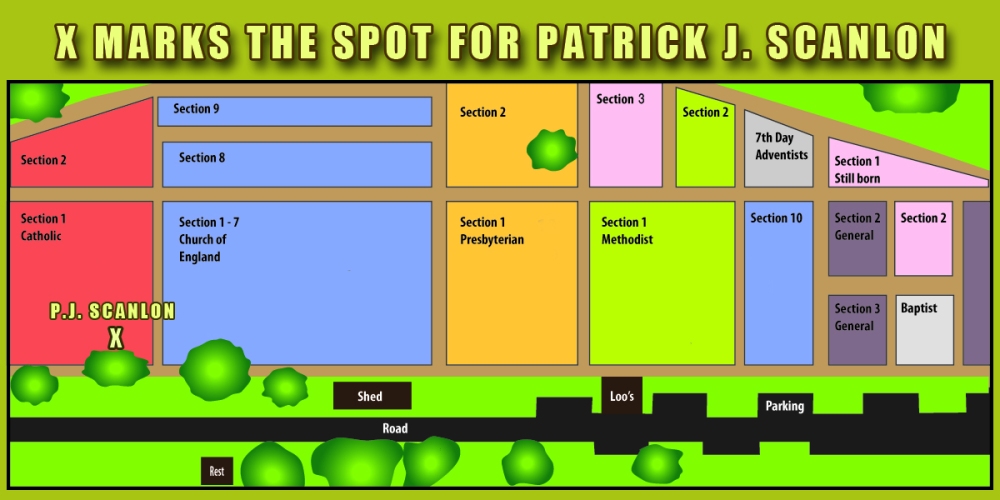
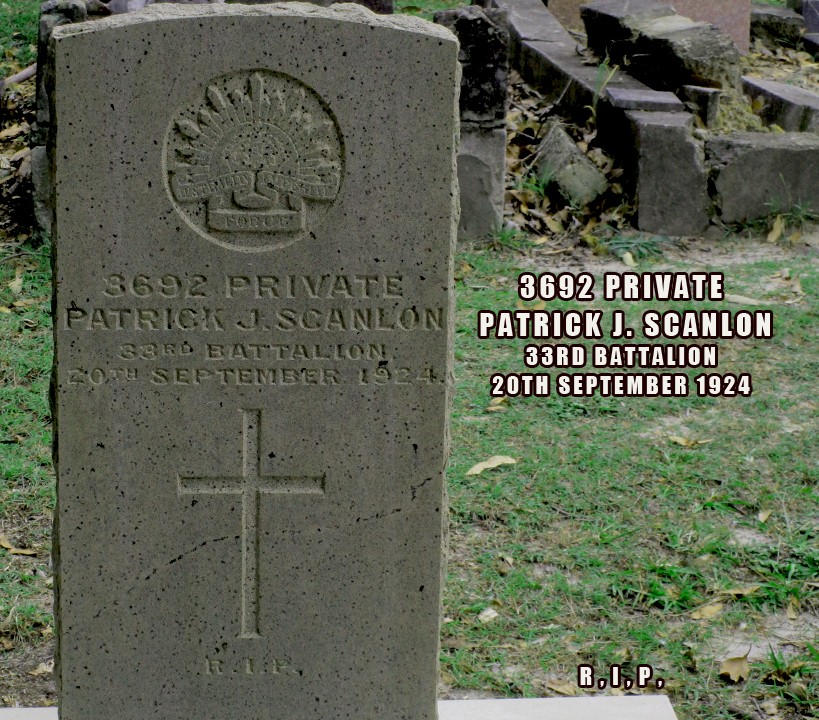
Patrick Joseph Scanlon                  20th September, 1924,                   Aged 40 years

Service number                                3682                       Brown Trachyte Military Stone

Roman Catholic,                               Section 1             Row 3                    Plot 1

Enlisted in 1917, aged 33 years. Was 5 foot 6inches tall with a fair complexion and auburn/red hair. His record notes his above the knee amputation (right leg) that happened after his term of service. He had been wounded in action, shot in the heel (again right leg) whilst serving. That injury to his heel and any further medical attention required for that heel was under the auspices of Veteran Affairs. Veteran Affairs appear to have paid for the false leg even though the heel injury was no more.

scanlon stone

25th September, 1924

P. J SCANLON.

On Saturday morning last, the death, occurred at the residence of his mother, Mrs. McCarthy, Gertrude Street, Gosford, of Mr. Patrick Joseph Scanlon, aged 40. He was a native of Quirindi, but had resided for some time in this district, and enlisted from Gosford for the A.I.F.

He served in the 33rd Battalion, and was wounded at the front in the ankle, and also gassed.

After his return to Australia he was thrown from a train while in charge of some horses returning from Canterbury Races; and a train passing on the next line severed one leg. He was a well-known figure about Gosford of late years, and many friends regret death, and express sympathy with relatives.

 Mr. Scanlon (who was generally known as McCarthy, his mother having married a second time) leaves a widow and a son nine years of age. Another son died at the age of five months while Mr. Scanlon was away with the A.I.F. The deceased ex-soldier had been ill for some time, and during –last week became much worse. Medical attention was given, but death came from heart failure. The funeral moved to Point Clare Cemetery on Sunday and was very largely attended.

The Rev. Father Donovan performed the last rites; and a number of wreaths were laid on the casket. Returned soldiers attended in uniform, and six of their number acted as pall-bearers.
25th September, 1924

DEATH.

SCANLON.— September 20th, 1924, at the residence of his mother, Gertrude Street, Gosford, Patrick Joseph Scanlon, aged 40 years.

R.I.P.

Service record for Scanlon

https://recordsearch.naa.gov.au/SearchNRetrieve/Interface/ViewImage.aspx?B=8078490

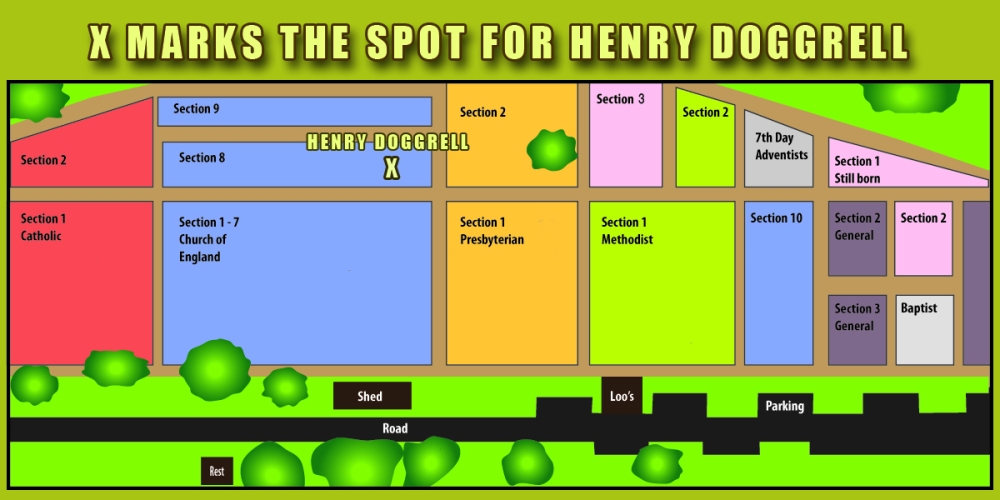
Henry Doggrell

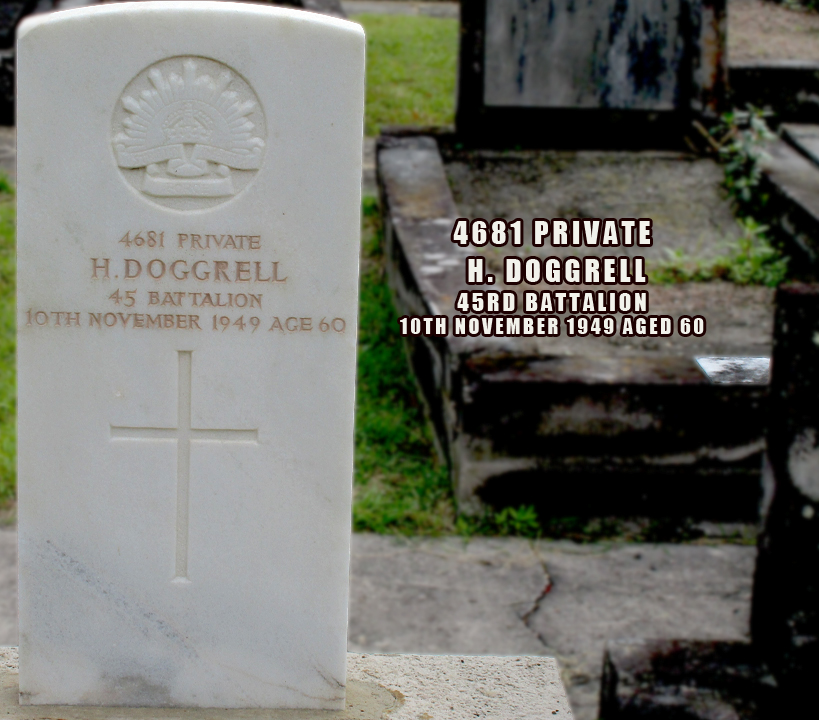
Henry Doggrell                 10/11/1949         Aged 60

Service number                4681                    White Marble Military Stone

C of E                                  Section 8             Row 7    Plot  M3

Henry Doggrell enlisted in July 1915, He was an Englishman born in Dorsett, near the town of Shaftsbury.  He was 26 years and 10 months. He had a fresh complexion, blue eyes, and brown hair. He was 5 foot seven inches tall. He was Church of England. He arrived in England by August 1916. He was wounded in action by March 1917 with a gunshot wound to the left leg/thigh. He returned to Australia by April1917. He was Medically Discharged August 1917. Awarded a pension of £3 per fortnight.

doggrell stone

11th November 1949

Man Collapses and Dies In Garden –
Henry Doggrell, 60, collapsed and died in his garden at his home at 75 Hill Street, Gosford, yesterday afternoon about 5 o’clock. Brisbane Water Ambulance officials were told that Doggrell was chipping grass when he collapsed. Doggrell, who was a returned soldier, was a member of the Gosford Buffalo Lodge, of which he was a K.O.M. (Second highest rank)

Mr R. H. Creighton, of Gosford, will conduct the funeral to Point Clare Cemetery today.

The Royal Antediluvian Order of Buffaloes (RAOB) is a fraternal organisation which assists members, their families and charities. It has a tiered structure, with a Grand Lodge, Provincial Grand Lodges and Minor Lodges. Originating in Drury Lane, London, in 1822 when a group of actors set up various lodges as they toured the country, it is now active globally, particularly in former parts of the British Empire. In Sydney the first recorded meetings date from 1882.

45th battalion                                  

Service record for Henry Doggrell

https://recordsearch.naa.gov.au/SearchNRetrieve/Interface/ViewImage.aspx?B=3511460

wo both rave

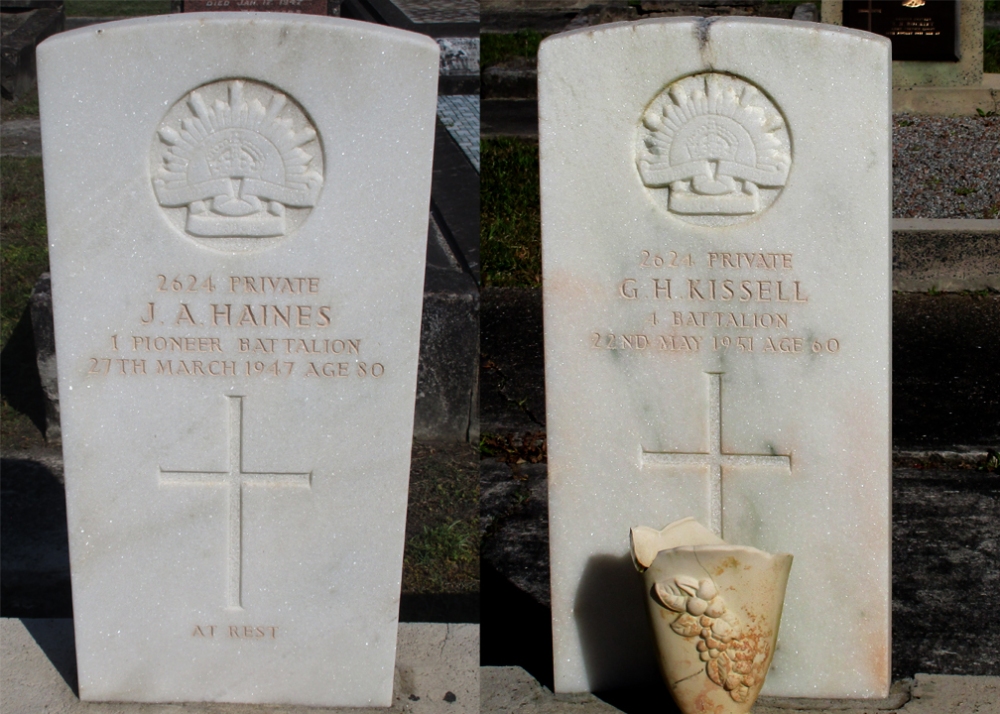
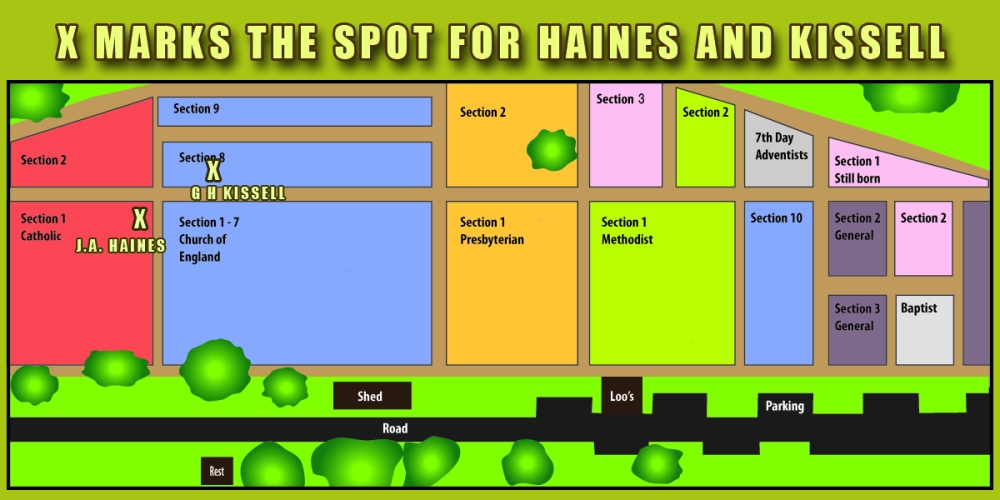
Haines and Kissell

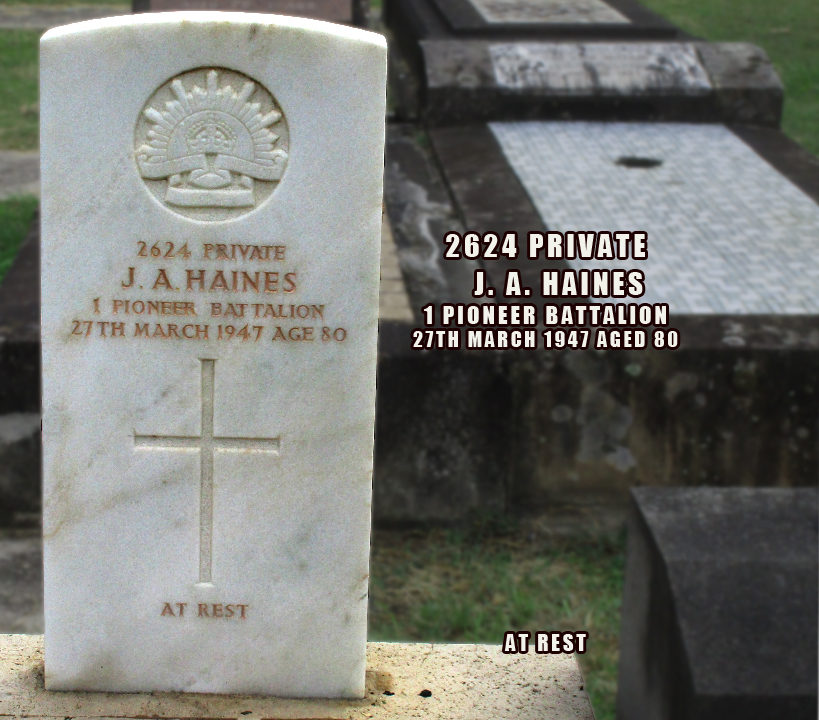
Both Service Number 2624

Both these men are returned servicemen from the First World War. Both of these men survived the ordeals of what the war threw at them. Both of these men received the honour of receiving a beautiful white marble headstone courtesy of the Commonwealth War Graves Commission.

John Albert Haines                                         27/3/1947            Aged 75

Service number                2624                       White Marble Military Stone

 C of E    Section 5             Row 2    Plot 32

He enlisted in May 1916, aged 44 and 5 months… He was 5 foot 6 inches tall… 13 stone…Dark hair eyes grey with a dark complexion… He embarked August 1916 and served in France for 18 months…He caught the flu which turned into Bronchitis, was unable to train and was a medical discharge 23/12/19  He was a Bootmaker by trade… Ran the Blackwall Post Office he played cricket… was good friends of the Singleton and Buttwell Families… he took Gosford Council to court over the appointment of a staff member without applying the correct procedures… and was the first Secretary of the Woy Woy Branch of the RSL.

There are three mistakes about this stone, one is his age at death… if you do the maths based on his war service record he was 75 not 80 when he died. The cut off age for the Army Service was 45 years, maybe Haines shaved off 5 years when he joined and the family put forward the correct details (?).

The other two mistake are possibly his service number as stated on the stone and that the War graves Commission has it listed as a trachyte stone not white marble.

haines stone type

The following article from the local paper is about his son.

13th February 1930

SUCCESSFUL SCHOLAR.

Mr. and Mrs. J. A. Haines, of the Blackwall Post Office, have every reason to feel proud of their son John Haines junior, who is employed at the Standard Weighgoods Works at Clyde, was successful in the fitting and machinery section of the recent technical examinations, and shows good promise of making big strides in the engineering world.

Haines’ War Service Record

http://recordsearch.naa.gov.au/SearchNRetrieve/Interface/ViewImage.aspx?B=4266409

kissell stone

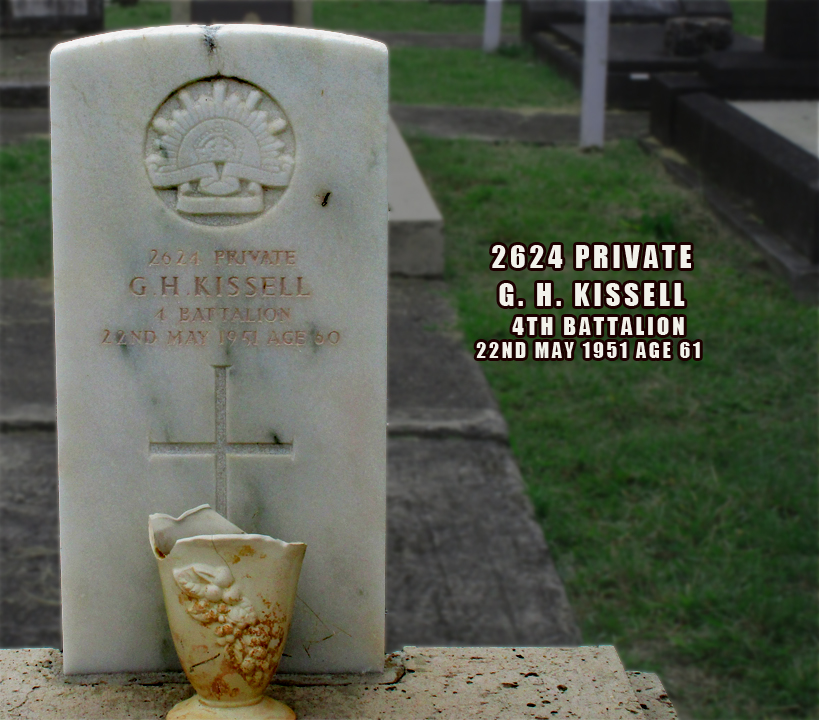
George Henry Kissell     22/5/1951            Aged 60

Service number                2624                    White Marble Military Stone

 C of E    Section 8             Row 12               Plot 18

Enlisted 30 June, 1915… He was living in Bathurst NSW… He was aged 25 years 1 month… He was a labourer. He was 5 foot 4 inches tall… He had a fair complexion, grey eyes and brown hair… He was Church of England He embarked from Australia 9/8/15… He had trouble with his teeth that required medical intervention… He reported to the venereal diseases hospital four times… Was transferred to the cycle Corps and went AWOL four times… was sent to France in January 1916… Sent to London in October 1917 went AWOL again four times… was sent to France in November 1916… wounded in Action January 1917… He went AWOL five times… wounded in Action a second time in October 1917… he kept up his AWOL ways and was finally charged with desertion, he was court marshalled and sentenced to 3 years at Pentonville Prison in Greater London on the 4th November 1918 (one week before the war was declared over 11/11/1918.) he was released from gaol on 21/7/19 and deported to Australia on7/9/19… there is a big stamp on his war service record “Not Eligible For Medals”.

Kisssell’s War Service Record

http://recordsearch.naa.gov.au/SearchNRetrieve/Interface/ViewImage.aspx?B=7373428

This is where these two returned service men have a historical crossing over by having the same identical service numbers. Service numbers are to be allocated to each individual and are generally not supposed to be reused. But during WW1, this pre computer/non centralised data based era, it was common for multiple servicemen to have the same number.

These incidences of multiple men having the same service number happened once someone with the number died during the war, the service number was reissued. Usually they would add a ‘A’ before the number to denote that it was a reissued number however sometimes they did not.

two same numbers

In the case of Haines and Kissell, in this instance, it looks like a mistake of some sort of administrative type. Haines died in 1947 and Kissell in 1950 (or 1951), both servicemen well after the Wars (both of them WW1 and WW2). Also what are the odds of someone being buried within 50 meters of the other out of the 160,000 who enlisted in WW1, with the same service number.

digger 2

By having a good look at the service records using the links provided Haines has some red pen adding as number 2624 on the front of his file, but my money is on Kissell being the true 2624 although in 1936 on page 7 of Kissell’s record it is noted in handwritten scrawl “No record of 2624 Kissell G. E., 4th Battalion – Is this the man?”. (Note the red pen on Haines records page 5…the service number looks like a later addition) So even at the time of the records being written there was some degree of confusion about these men.

popplewell

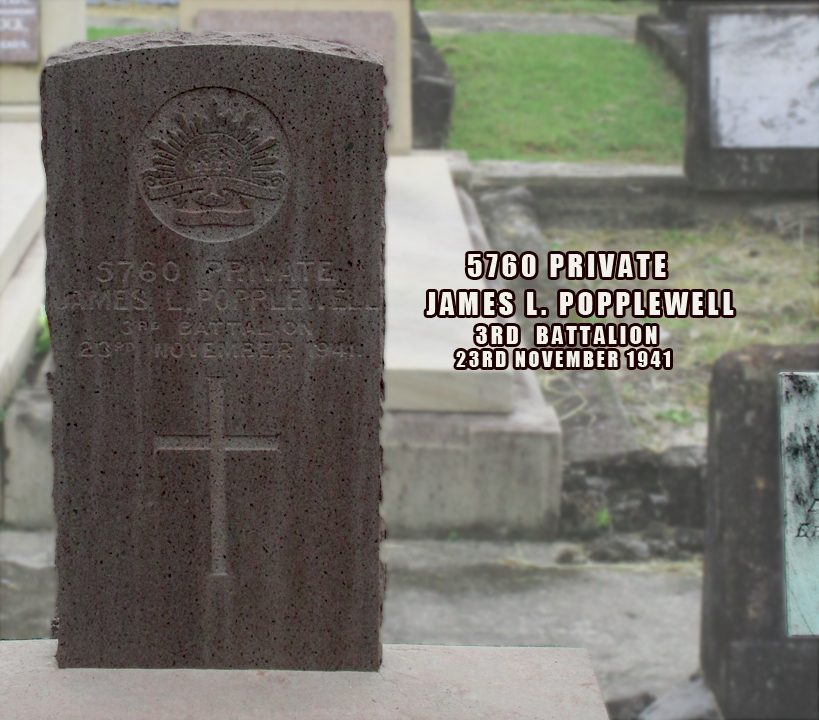
James Lawrence Popplewell      23/11/1941         Aged 63

Service number                5760                       Brown Trachyte Military Stone

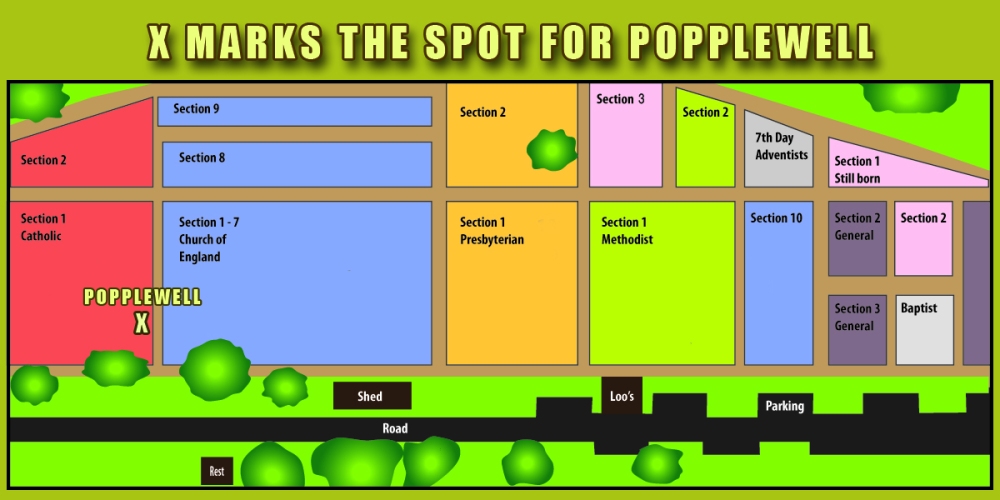
RC but buried C of E        Section 5             Row 1    Plot 18

James Lawrence Popplewell was born in New Zealand and Enlisted February 1916… He was 36 years and five months old and married… a cook and baker by trade… he was Roman Catholic, he has a vaccination scar and it is noted “that he is giving no trouble”. Embarked for Europe in June 1916, was in England with Bronchitis in Dec 1916. He was transferred to France, October 1917 and very quickley wounded in action in October 1917 by a shell wound to the Left shoulder and buttocks and repatriated to England. He was medically discharged in October, 1918.

popplewell stone

Popplewell’s War Service Record

https://recordsearch.naa.gov.au/SearchNRetrieve/Gallery151/dist/JGalleryViewer.aspx?B=8016767&S=1&N=15&R=0#/SearchNRetrieve/NAAMedia/ShowImage.aspx?B=8016767&T=P&S=3

 mcintosh

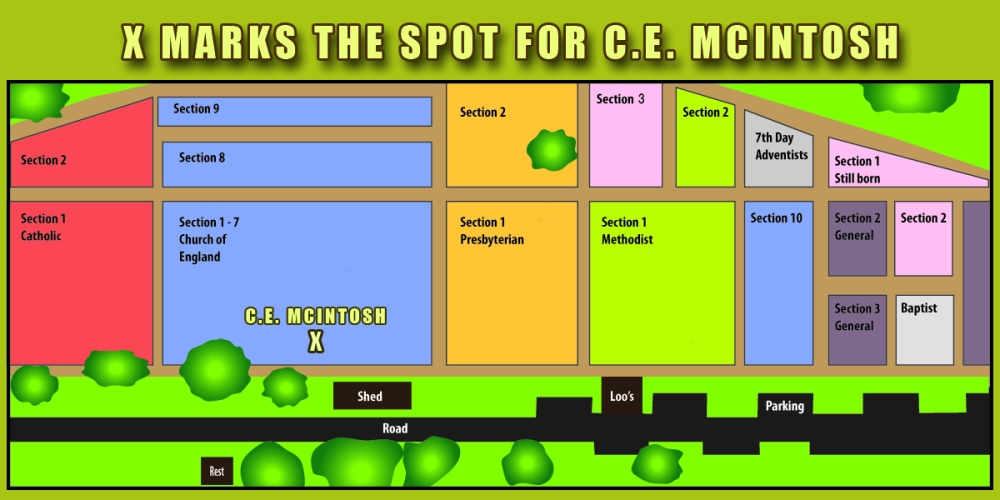
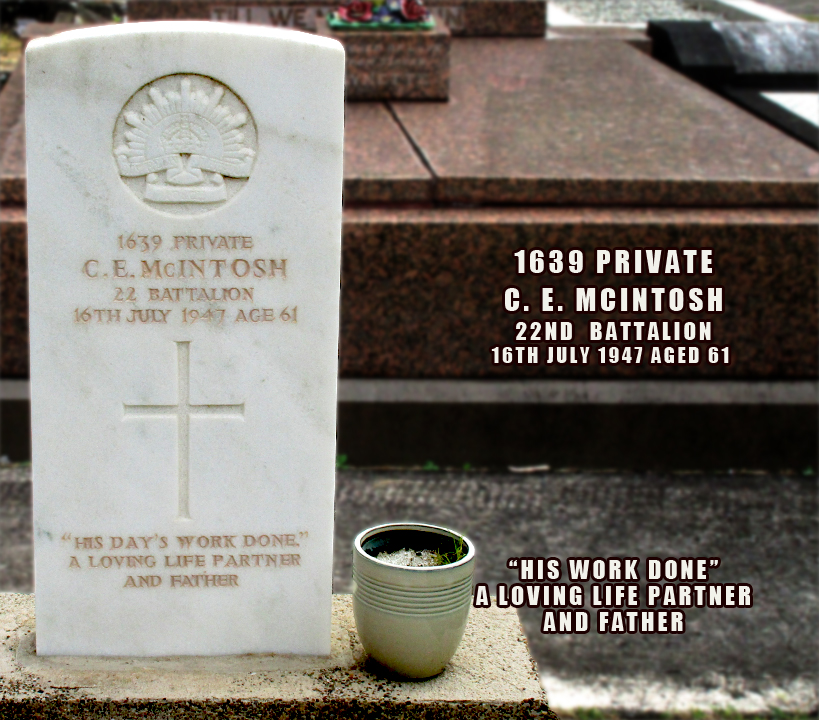
C.E. McIntosh 16/7/1947            Aged 61

Service number                1639                       White Marble Military Stone

RC but buried C of E        Section 3             Row 3    Plot 75

C. E, McIntosh 29 years and 1 Months of age when he enlisted in June 1915… he was 5 foot 3 inches tall, ruddy complexion with blue eyes and dark brown hair… He had a scar below both knees and a mole between the shoulders… He was a Baker/ Cook by trade… There is a wife noted, but then a further note states that she is dead…Arrived December 1915 ANZAC… sent to VD Hospital in Suez January 1916… in September 1916 Invalided to Australia medically unfit due to VD… In 1957 his son and lost contact with his father and was in Callan Park Mental Institution. The army had to inform the son that his father had died some 5 years earlier.

ce mac

McIntosh’s War Service Record

https://recordsearch.naa.gov.au/SearchNRetrieve/Gallery151/dist/JGalleryViewer.aspx?B=1946372&S=1&N=21&R=0#/SearchNRetrieve/NAAMedia/ShowImage.aspx?B=1946372&T=P&S=21

And just when you think the Commonwealth War Graves Commission has made a further mistake there actually is another McIntosh C. in the graveyard.


macintosh 2

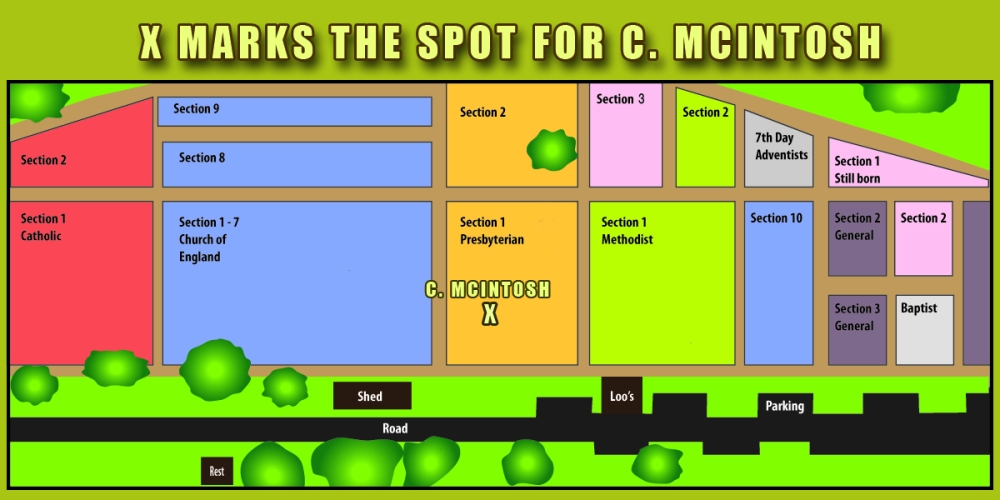
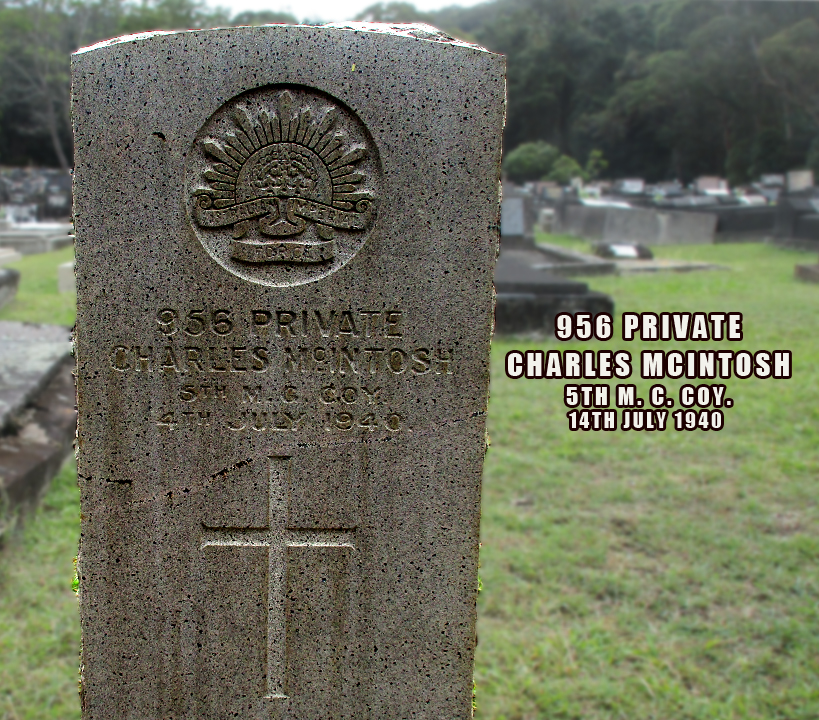
C. McIntosh                 16/7/1940            Aged 65

Service number                956                         Brown Trachyte Military Stone

Presbyterian                      Section 1             Row 4                    Plot 28

Charles McIntosh enlisted in February 1915 and has a very low service number with only three digits was 39 years and 7 months of age… he puts his trade as Steel Smithing… he had previously seen battle action with the South African Volunteers… he was 5 foot 10 inches tall, dark complexion, dark eyes and dark hair… He was Presbyterian… In September 1917 he had a gunshot wound to the chest… He was discharged in March 1918… In 1940 there seemed to be a hitch with his estate. There is a letter requesting  the locations of the witness’s to his Will, that he wrote whilst in the Army. The Army had to write back to inform them that both of the witness’s to his Will had been killed in Action.

c mac

C.McIntosh’s War Service Record

https://recordsearch.naa.gov.au/SearchNRetrieve/Interface/ViewImage.aspx?B=1946361


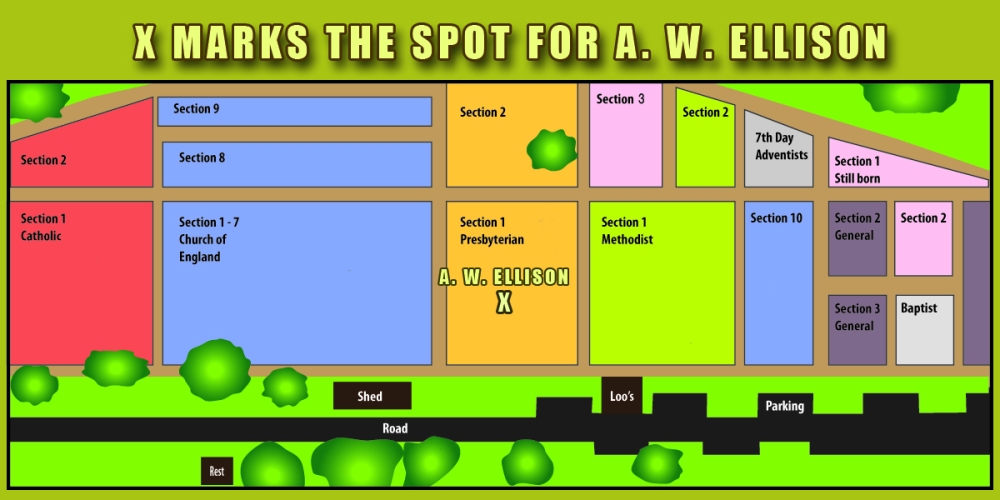
ellison map

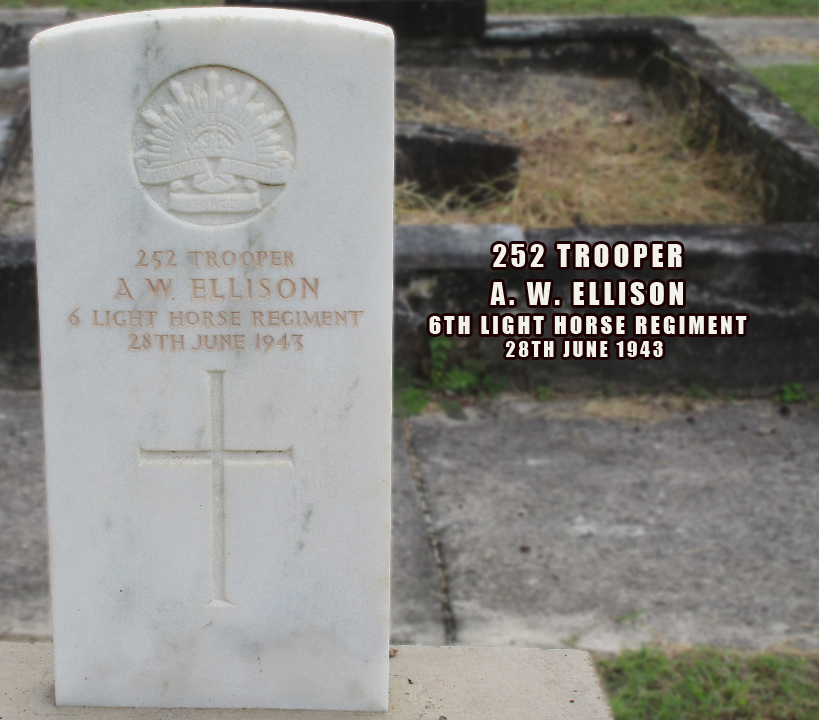
Alexander William Ellison                           28/6/1943            Aged 64

Service number                252                         White Marble Military Stone

Church of England                                           Section  5            Row 3    Plot  72

Alexander William Ellison enlisted just one month after the beginning of World War 1 in August 1914, hence is extra low, three figured service number.

He was born in Adelaide and was 36 years 3 months of age… He was 5 foot 5inches tall with brown hair brown eyes… He was a horse Groom… He was a Trooper with the 6th Light Horse He was Church of England… Enlisted august 1914… Went to Malta… Caught Dysentery at Gallipoli…  August 1915… December 1915… Medically discharged June 1916 Suffering from nervousness, very weak, loss of flesh, diarrhoea and recommended for further treatment. 2 months convalesce. He was married to Agnes Ellison who applied for a Widow’s badge in March 1945 to be told that they did not make them anymore.

Commonwealth War Graves commission has this stone in their records as a trachyte granite stone.  

ellison stone

Ellison’s War Service Record

https://recordsearch.naa.gov.au/SearchNRetrieve/Gallery151/dist/JGalleryViewer.aspx?B=3541347&S=1&N=58&R=0#/SearchNRetrieve/NAAMedia/ShowImage.aspx?B=3541347&T=P&S=58


12th July 1917
THE ANZACS’ DICTIONARY.
Language of the Trenches.
The following is a list of words or phrases used in the trenches in Flanders :—
Aussie ( “Ozzy”):                     An Australian soldier.
Tommy or Choom :                An English soldier.
Jock :                                           A Scotch soldier.
Zealand :                                   A New Zealand soldier. (Call him Pig Island if you would make him wild.)
Fritz :                                          A German soldier.
Savee :                                        Do you know.
Compree :                                  Do you understand.
Imshi :                                        Clear out.
Backshee :                                 Something for nothing.
Chatty :                                       Affected with trench vermin, known as chats.
Clink :                                         Gaol
Bird :                                           Prisoner.
Quack :                                       The army doctor.
Swinging the Lead :                Evading service ; malingering.
The Heads :                              Those in authority.
Dead Meat Tickets :               Identification
Tray Bong :                               Very good.
Hickory :                                    Be off.
Barometer                                Gas helmet.
Tin Hat :                                     Steel helmet.
Shooting Stick :                        Rifle.
Ham and Chicken :                 Ammunition.
Mills’ Pills :                               Mills’ hand grenades.
No. 9 :                                          Pills ordered by the army doctor.
Freak Villa :                              The cook-house.
Babbling Brook :                      The cook.
Iodine Villa :                             Where the doctor rests his patients.
Army Nervous Corps :           Service Corps. ,3V
Dinkum Oil :                             Straight information.
Napooh Mafeesh :                   The finish.
Dopey :                                       Silly.
One-star Artist :                      A second lieutenant.
Tanks or Oases :                      Army boots.
Mad Mick and Banjo:             Pick and shovel.
Knocked :                                  Wounded.
Skittled :                                    Killed.
To get a Blighty :                     To be wounded and sent back to England.
Home and Dried :                   Safe and sound.
Hop Over                                  To go over the trenches towards the enemy.
Iron Rations for Fritz :          Shells for the enemy
Comfort                                     Funds Shells.
Fags :                                           Cigarette.
Step the Gutter :                      Pass the butter.
Jack Scratch                             Got a match
Wandering Jew :                     Stew.
Dodger :                                     Bread.
Possie :                                       Position.
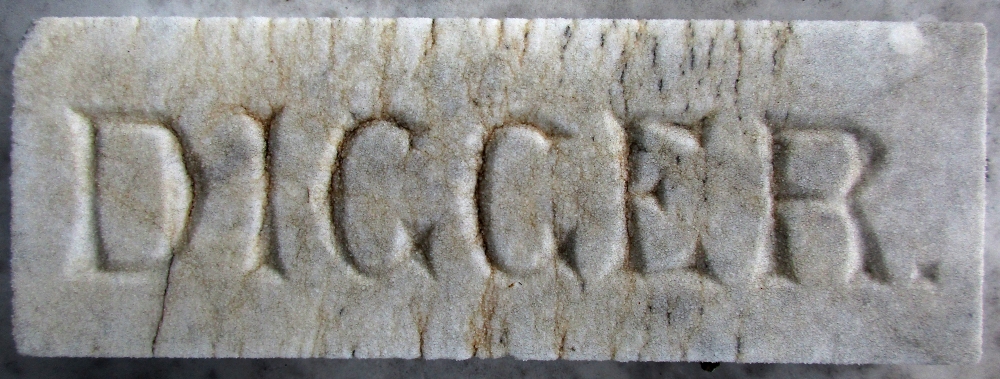
Digger :                                      A West Australian.
Jack, Charlie, Mac. :              A handy name for anyone.
Dag :                                           A character, a ‘ hard case.
Windbag :                                A talker out of his turn.